

Letter to the Speaker
July 2015
The Honourable Dave Levac
Speaker of the Legislative Assembly of Ontario
Room 180, Main Legislative Building
Queen’s Park
Toronto, Ontario
M7A 1A2
Dear Mr. Speaker:
In accordance with section 14 of the Financial Accountability Officer Act, 2013, I am pleased to present the 2014-15 Annual Report of the Financial Accountability Officer for your submission to the Legislative Assembly at the earliest reasonable opportunity.
Sincerely,
 Stephen LeClair
Financial Accountability Officer
1. Introduction
This is my first annual report as Financial Accountability Officer (FAO). Its purpose is twofold. First, in accordance with section 14 of the Financial Accountability Officer Act, 2013 (the Act), I wish to report on the work conducted by my office since my appointment in March 2015. Second, I want to lay out my expectations for how I plan to perform my duties as FAO in the months and years to come.
The way in which my office will operate reflects the Legislature’s intention, as delineated in the Act, that I provide the Legislative Assembly with independent, timely and relevant economic and financial analysis to which MPPs have not always had access.
The Act protects my independence and requires my impartiality; mandates that I use professional judgement to conduct analysis on my own initiative while responding directly to the research needs of MPPs and committees; guarantees my access to the information I need to perform that analysis and research; and requires that I report regularly on my work and be held accountable for it.
In the past few months, I have begun to put in place policies that build on the Act, reflect Canadian and international best practices and allow my office to provide the Legislative Assembly with the economic and financial analysis it needs.
I am hiring staff who understand the importance of this office’s independence and impartiality and have the education and experience to perform timely and relevant analysis. Clear criteria are in development to determine when I will exercise my discretion to refuse research requests from committees or MPPs. I am working with the Secretary of the Cabinet and other deputy ministers in the Ontario Public Service to develop clear and effective procedures for accessing information held by ministries and public entities needed to perform my duties.
My office has also started to perform its analytical work. I have initiated an analysis of the impact of the proposed Hydro One initial public offering (IPO) on the province’s finances, which I plan to publish this fall. My staff are also laying the groundwork for the release of the office’s first regular products in fall 2015 and winter 2016.
In the coming months and years, I look forward to working with MPPs and the committees on which they serve to ensure that my office will provide them with economic and financial analysis that meets their needs and ultimately helps better inform all Ontarians about the state of the province’s economy and finances.
Sincerely,
Stephen LeClair
Financial Accountability Officer
2. Financial Accountability Officer’s Role
The Financial Accountability Officer (FAO) was created as Ontario’s newest officer of the Legislative Assembly when the Legislature enacted the Financial Accountability Officer Act, 2013 (the Act) in September 2013. Stephen LeClair was appointed as Ontario’s first FAO in March 2015.
The proposal for creating the FAO originated in a budget deal reached by the Liberals and New Democrats in May 2013. In September 2013, the Minister of Finance introduced the bill creating the FAO, which enjoyed the support of all three parties throughout the legislative process. While the bill was being considered by the Standing Committee on the Legislative Assembly, MPPs from all parties proposed and supported several amendments that clarified the FAO’s mandate, and strengthened the FAO’s access to information and independence from government.
The debates on the creation of the FAO make clear the contribution that MPPs expect the FAO to make. They want the FAO to provide them with independent, relevant and timely economic and financial analysis. MPPs need economic and financial analysis to help them perform their three main constitutional duties: approving the government’s fiscal plan, debating and passing legislation and scrutinizing government activities. MPPs’ lack of access to such analysis makes it difficult for the Legislative Assembly to conduct a detailed review of government’s fiscal plan and costs and benefits associated with the policy choices that the plan reflects.
In his 2012 annual report, then-Auditor General Jim McCarter identified several constraints on the ability of the Standing Committee on the Estimates to review the government’s projected expenditure and revenue. The Auditor General noted that, unlike the Standing Committee on Public Accounts, the Standing Committee on the Estimates lacks specialized staff support. The Auditor General identified several models through which such support could be provided to the Estimates committee and the Legislative Assembly more broadly, including the creation of an
Lack of access to information and analysis makes it hard for MPPs to scrutinize government activity. Such scrutiny work takes place largely through committees. Standing committees in Ontario tend to produce relatively few substantive reports, with most such work being conducted by select committees, often formed at the behest of the government and focused on specific questions.
Larger economic and financial issues, including the sustainability of the province’s finances or long-term trends in Ontario’s economy and labour market, are left largely unexplored by most committees with the notable exception of the Public Accounts committee, which is supported by the Auditor General and focuses on following up on her reports and directing her office to pursue special assignments. The FAO seeks to complement, rather than duplicate the important role played by the Auditor General. The FAO looks forward to working with the Auditor General to avoid duplication and overlap in their work programmes.
The FAO’s role is to help MPPs better perform their constitutional duties by informing their review of the government’s fiscal plans, supporting their examination of the economic and financial impact of individual bills and assisting their ongoing scrutiny of the government’s economic and fiscal policies. By helping MPPs perform their duties, the FAO’s work should, according to international and Canadian evidence, encourage the government to improve the quality of its economic and financial forecasts, both at the aggregate level and as they relate to particular bills or proposals.
The role that MPPs intended for the FAO is reflected in several aspects of the legal framework they provided for the FAO, which meets or exceeds international standards for independent fiscal institutions established by the Organisation for Economic Co-operation and Development (OECD) (Fig. I). As an officer of the Assembly, the FAO enjoys independence from the government of the day. The FAO is mandated to provide the Legislative Assembly with economic and financial analysis on his own initiative while also responding to requests for research and assistance. The FAO has a broad power to access most unpublished and confidential information held by ministries and other public institutions necessary for the performance of his duties.
Fulfilling the Legislative Assembly’s intentions when it comes to the FAO’s role requires the FAO to adopt policies that help ensure that the Office’s independence is protected, that he is able to fulfill his mandate with the assistance of his office, that he has access to the information his office needs to perform economic and financial analysis, and that he is able to report the results of his office’s work to the Legislative Assembly and be held to account for it. The rest of this report identifies steps the FAO has taken to fulfil the trust the Assembly has placed in him and how he intends to continue to do so in the future.
| Principle | Legislation | Policy |
|---|---|---|
| 1. LOCAL OWNERSHIP | ||
| A. IFIs require broad national ownership, commitment and consensus across the political spectrum | Yes | |
| B. Local needs and the local institutional environment should determine an IFI’s role, structure, functions and protections | Yes | |
| 2. INDEPENDENCE | ||
| A. IFIs should be precluded from normative policy-making duties | Yes | |
| B. IFI leadership should be selected on merit and technical competence, without reference to political affiliation | Yes | |
| C. Leadership qualifications should be made explicit including professional standing and relevant experience | Yes | |
| D. Leadership terms lengths and numbers, and dismissal criteria and processes, should be specified in legislation | Yes | |
| E. IFI leadership terms should optimally be independent of the electoral cycle | Yes | |
| F. The head of the IFI should be a remunerated and full-time position, conflict-of-interest standards should apply | Yes | |
| G. IFI leadership should have full freedom to hire and dismiss staff in line with applicable labour laws | Yes | |
| H. Staff should be selected through open competition based on merit and technical competence, in line with civil service conditions and without reference to political affiliations | Yes | |
| 3. MANDATE | ||
| A. An IFI’s mandate should be defined in legislation, including required reports, analysis, recipients and timelines | Yes | |
| B. IFIs should have scope to produce reports within their mandate at their own initiative and autonomy to determine their own work programme | Yes | |
| C. Clear links to the budget process should be established within an IFI’s mandate | Yes | |
| 4. RESOURCES | ||
| A. The resources allocated to IFIs must be commensurate to their mandate | Yes | |
| B. IFI appropriations should be published and treated in the same manner as the budgets for other independent bodies | Yes | |
| C. Multi-annual funding commitments may further enhance an IFI’s independence and provide additional protection from political pressure | No | |
| 5. RELATIONSHIP WITH THE LEGISLATURE | ||
| A. Mechanisms should be put in place to encourage appropriate accountability to the legislature | Yes | |
| B. The role of the IFI and Parliament’s budget committee (or equivalent) should be established in legislation | Yes | |
| 6. ACCESS TO INFORMATION | ||
| A. IFIs should have full access to all relevant government information in a timely manner and at no cost | Yes | |
| B. Any restrictions on access to government information should be clearly defined in legislation | Yes | |
| 7. TRANSPARENCY | ||
| A. IFIs should act as transparently as possible including in their work and operations | Yes | |
| B. IFI reports, analysis, underlying data and methodology should be published, made freely available to all and sent to Parliament | Yes | |
| C. The release dates of an IFI’s major reports and analysis should be formally established | No | |
| D. IFIs should release their reports and analysis, on matters relating to their core mandate, in their own name | Yes | |
| 8. COMMUNICATIONS | ||
| A. IFIs should develop effective communication channels from the outset | Yes | |
| 9. EXTERNAL EVALUATION | ||
| A. IFIs should develop a mechanism for external evaluation of their work | Yes | |
3. Independence
The FAO and his staff must be independent from influence by the government of the day in order to provide the Legislative Assembly with the impartial analysis it needs to perform its constitutional duties and help ensure that the government makes prudent projections and policy choices. The FAO and his staff must also have sufficient education and experience to ensure their work is credible and professional.
Several provisions of the Financial Accountability Officer Act, 2013 work in concert to bolster and protect the FAO’s independence, impartiality and professionalism:
OFFICER OF THE ASSEMBLY
The FAO is designated as an “officer of the Assembly” under section 2 of the Act, putting him on par with the Auditor General, the Chief Electoral Officer, the Environmental Commissioner, the French Language Services Commissioner, the Information and Privacy Commissioner, the Integrity Commissioner, the Ombudsman and the Provincial Advocate for Children and Youth.
APPOINTMENT
The FAO is appointed under section 2 of the Act by Cabinet on address of the Legislative Assembly if the proposed appointee has first been approved by an opposition-majority panel of three MPPs chaired by the Speaker. This provision ensures that the FAO’s appointment must be approved by all recognized parties in the Legislative Assembly.
TERMS OF SERVICE
The FAO serves for a fixed five-year term according to section 2 of the Act and can be reappointed for one additional term. As with provincial judges, the FAO can only be removed for cause on address of the Assembly. The FAO is barred from holding any other employment that would conflict with the performance of his duties.
SALARY, EXPENSES, BUDGET AND STAFFING
According to sections 3, 5 and 8 of the Act, the FAO’s salary and expenses, as well as budget and staffing levels for his office, are approved by the Legislative Assembly’s Board of Internal Economy, rather than the Treasury Board, the permanent Cabinet committee responsible for approving budgeting and management decisions made within the public service.
In April 2015, the FAO submitted an operating plan and proposed budget for the first two years of his office’s work to the Board of Internal Economy for its review and approval. The operating plan and proposed budget are available on the FAO’s website.
QUALIFICATIONS OF STAFF
Under section 8 of the Act, the FAO has the power to hire staff for his office. The FAO has started to staff his office with employees who have both experience and graduate education in economics or finance. Since many of those with the requisite experience at the provincial level may work in the Ontario government, the FAO will pursue the development of a formal understanding with the Secretary of the Cabinet allowing for two to three year secondments to the FAO.
TERMS AND CONDITIONS OF EMPLOYMENT
Under section 8 of the Act, the FAO can set the terms and conditions of employment for his staff. The FAO requires that his staff not engage in other work or activities that would interfere with their contribution to the FAO’s performance of his duties. As an independent officer of the Legislative Assembly the FAO will establish a code of conduct consistent with that of the Legislative Assembly. Currently, the FAO requires that staff respect the Legislative Assembly’s Code of Conduct as a condition of employment.
IMMUNITY
Under section 17 of the Act, the FAO and his staff enjoy immunity from civil proceedings for any actions taken in good faith in the performance of their duties.
INTERFERENCE AND OBSTRUCTION
Section 18 of the Act provides that the FAO can refer actual or attempted interference with or obstruction of his work by an MPP or their staff, including those employed in a minister’s office, to the Speaker of the Legislative Assembly for his review. This provision was added while the legislation creating the FAO was before the Standing Committee on the Legislative Assembly with the express intention of protecting the FAO’s independence.
4. Mandate
The Financial Accountability Officer(FAO) has a three-part mandate under sections 10 and 11 of the Financial Accountability Officer Act, 2013:
- Providing independent economic and financial analysis to the Legislative Assembly on his own initiative;
- Responding to requests from MPPs and committees for economic and financial research;
- Attending meetings of the Standing Committee on Finance and Economic Affairs and providing assistance to the committee at its request.
Whether on his own initiative or by request, the FAO can direct his office to examine both the broad state of the Ontario government’s finances and the province’s economy and more specific economic and financial questions, including the economic and financial impact of the government’s estimates and supplementary estimates, bills before the Legislative Assembly and policy proposals that fall within the Legislature’s jurisdiction.
The flexible structure of the FAO’s mandate will allow the FAO to use his professional judgement to bring significant economic and financial issues to the Legislative Assembly’s attention, while meeting the immediate needs of MPPs and committees by responding to research and assistance requests.
The FAO will use economic and financial methodologies that reflect Canadian and international best practices. Where appropriate, the FAO will draw on outside experts to serve as peer reviewers to ensure that the analysis that the FAO provides the Legislative Assembly is of the highest possible quality.
A. Economic and financial analysis
The FAO will produce three types of regular reports:
Short-term analysis of the government’s fiscal and economic plan
Short-term analysis of the government’s fiscal and economic plan Starting in fall 2015, the FAO will produce regular reports on the implementation and results of the annual budget. These reports will highlight material changes to underlying economic and fiscal assumptions originally set out in the budget and the consequential impact on the province’s overall fiscal plan (e.g. surplus/deficit, borrowing requirements, overall net financial debt, etc.)
Medium-term economic and financial analysis and projections
Starting in spring 2016, the FAO will produce an annual post-budget report, which will analyze the economic and fiscal assumptions that have the greatest potential influence on the feasibility of the province’s fiscal plan and present different scenarios based on the degree of uncertainty and risk associated with the underlying assumptions.
Starting in fall 2015, the FAO will also produce regular reports which will provide detailed assessments of the projected expenditure and revenue impact of new policies announced in the government’s annual budget. The FAO is currently preparing its first such report, which will examine the impact of the proposed initial public offering (IPO) of Hydro One on the province’s finances.
Long-term economic and financial analysis
Starting in fall 2016, the FAO will produce an annual Fiscal Sustainability Report using a methodology similar to that established by the United Kingdom’s Office of Budget Responsibility.
The FAO may also produce occasional reports that fall outside these categories. For instance, the FAO plans to conduct a review of the level of economic and financial information and analysis the government provides the Legislative Assembly in support of its annual budgets and fall economic statements and to the Standing Committee on the Estimates in support of its review of the government’s estimates and supplementary estimates.
B. Economic and financial research requests
The FAO will receive and consider research requests from MPPs and committees confidentially. If the FAO accepts a research request from an MPP or a committee, the FAO will develop terms of reference in consultation with the MPP or committee. The FAO will publicly disclose the research requests he has accepted on his website, but will not reveal the identity of the requesting committee or MPP.
The FAO is empowered to refuse research requests from MPPs and committees. Since the number of requests is likely to outstrip the FAO’s financial and human resources, the FAO expects the need to exercise discretion to refuse requests. If the FAO decides to refuse a request, written reasons for doing so will be provided to the MPP or committee within 30 days of receiving the request, unless a determination is made by the FAO that more time is required to assess the request. The FAO’s future annual reports will include statistics on the number of requests received, the proportion refused and the reasons for refusal.
The FAO will use the following principles, which are based on Canadian and international best practices, to guide his decision to accept or refuse a research request. These principles have been circulated to the members of the Standing Committee on Finance and Economic Affairs for their comment and the FAO looks forward to drawing on their input to further refine the principles in the future.
SCOPE OF MANDATE
The FAO will refuse requests that fall outside his mandate to conduct economic and financial research. The FAO respects the role played by other officers of the Assembly, notably the Auditor General, so he will also refuse requests that would be better fulfilled by another institution.
FEASIBILITY
The FAO will refuse requests where it is either not possible to agree on terms of reference with the requesting committee or MPP or where, according to his professional judgement, the request cannot be fulfilled with any degree of certainty
INFORMATION ACCESS
The FAO will refuse requests for which the information required to conduct the research is not likely accessible because the necessary information does not exist and cannot be produced from existing sources.
PROVINCIAL IMPACT
The FAO will refuse requests that, according to his professional judgement, concern aspects of the government’s estimates, bills or proposals that cannot be reasonably expected to have a substantial impact on the province’s finances – e.g. its revenue, expenditures or debt – and/or the provincial economy – e.g. its gross domestic product or employment rate.
REGIONAL AND DEMOGRAPHIC IMPACT
However, the FAO is willing to consider requests that involve matters which may not have a substantial economic or financial impact at the provincial level, but have a substantial impact in a particular region of the province. The FAO is also willing to consider requests that involve matters that have substantial impacts on particular groups, such as students or seniors.
RELEVANCE TO THE ASSEMBLY
The FAO will prioritize requests that, according to his professional judgement, are most relevant to his role of assisting the Assembly in performing its constitutional duties. As a result, the FAO will prioritize requests relating to government bills and policy proposals made by ministers over private member’s bills and proposals made by others. Increased scrutiny of the government’s fiscal plans, bills and proposed policies more generally should encourage the government to make prudent economic and financial projections and inform policy choices that are consistent with those projections.
DISSOLUTION AND PROROGATION
The FAO will refuse any requests that he receives when the Assembly is dissolved. Once the Assembly is dissolved, legally speaking, there are no longer any MPPs or committees from which he can accept requests. The FAO will also refuse requests when the Assembly is prorogued.
CONFIDENTIALITY
The FAO will refuse requests he receives for research that is to remain confidential or be released at the sole discretion of the requesting committee or MPP. The FAO was created to help inform the Assembly in order to improve its capacity to perform its constitutional duties. The best way he can do so is by reporting publicly to the Assembly as a whole.
WITHDRAWAL OF REQUESTS
The FAO will allow a committee or MPP to withdraw a request. However, if the FAO judges it appropriate, he may choose to continue to pursue the research they requested as though it were analysis that he undertook on his own initiative.
C. Assistance to Standing Committee on Finance and Economic Affairs
The FAO anticipates that the Standing Committee on Finance and Economic Affairs may request assistance in its pre-budget consultations and consideration of budget implementation legislation and other bills that fall within its remit, as well as any substantive inquiries into economic and financial issues that the committee might undertake. The FAO looks forward to working with the Finance committee’s members as well as its staff to identify how the FAO and his office can best assist the committee.
The FAO is also prepared to work with other committees at their request when they are considering legislation or conducting substantive inquiries that relate to the FAO’s mandate.
5. Access to Information
The FAO’s ability to provide the Legislative Assembly with economic and financial analysis depends on the FAO’s capacity to access information held by the Ontario government. Although some of the economic and financial information the FAO requires is already publicly available, much of it is not. The FAO’s need for internal government information is particularly important when it comes to examining the financial impact of a government bill or policy proposal. It is precisely this kind of information that those outside the government who comment on government bills or proposed policies, notably think tank- and university-based researchers, tend to lack.
The Legislature recognized the importance of the FAO’s access to information when, in section 12 of the Financial Accountability Officer Act, 2013, it imposed a clear duty on ministries and other public entities to provide the FAO in a timely manner with any information that he requests and considers necessary for the performance of his duties.
The FAO will publicly disclose information requests on the FAO website as soon as they are made and will post the responses received from ministries and public entities. In future annual reports, the FAO will report on the number of information requests made and whether access to information has been provided by ministries and public entities.
The FAO is exploring with the Secretary of the Cabinet and other deputy ministers the development of a comprehensive memorandum of understanding (MOU) that will govern the way in which ministries and public entities respond to the FAO’s information requests in light of a shared interpretation of the scope of their duty to provide information. If an MOU is agreed to, it will be made publicly available on the FAO’s website.
In defining the scope of the duty of ministries to provide the FAO access to information, the Legislature drew heavily on the existing structure of the Freedom of Information and Protection of Privacy Act. This allows ministries to draw on the existing procedures they have in place for dealing with freedom of information requests, but they must be mindful of the differences between the general right of individual Ontarians to access government information and the FAO’s specific right to access information necessary for the performance of his duties.
TIMELY MANNER
Ministries must provide the FAO with access to information within a timely manner. Sections 26 and 27 of the Freedom of Information and Protection of Privacy Act sets a general time limit of 30 days for government institutions to provide individuals access to information, subject to extension if many records are involved or extensive consultations with other institutions are required. The FAO expects that ministries should be able to provide the information he requests within 30 days, but is willing to grant reasonable extensions, provided that doing so would not undermine his ability to provide the Legislative Assembly with relevant and timely analysis. If the FAO does not receive a response from a ministry or public entity within 30 days, he will deem that they have refused the request, an interpretation consistent with section 28 of the Freedom of Information and Protection of Privacy Act.
CUSTODY AND CONTROL
Ministries must provide the FAO with information that is “in their custody or under their control”. The FAO considers that information is in their custody or under their control even if it is information that could reasonably be produced from existing databases, an interpretation consistent with section 2 of the Freedom of Information and Protection of Privacy Act. The FAO also considers that such information includes information concerning broader public sector organizations that fall within the FAO’s mandate, such as colleges, hospitals and school boards, and that are supervised by the ministry or public entity.
EXCEPTIONS TO ACCESS
There are currently two exceptions to the FAO’s access to information. A third will be added in December 2015.
Cabinet records exception
The FAO cannot access various kinds of information that would reveal the substance of Cabinet deliberations, as defined in section 12 of the Freedom of Information and Protection of Privacy Act (FIPPA). The exception is limited by paragraph 12(1)(c) of FIPPA, which allows for the disclosure of background information and analyses of problems submitted to Cabinet once the decisions to which they relate have been made and implemented.
Personal information and personal health information exception
The FAO also cannot access personal information and personal health information, which are defined in the Freedom of Information and Protection of Privacy Act and the Personal Health Information Protection Act, 2004, respectively. The exception covers various kinds of information about an identifiable individual.
When considering the legislation creating the FAO, the Standing Committee on the Legislative Assembly added a provision requiring ministries to redact personal information and personal health information. The express intention of this amendment was to maximize the amount of information that ministries can provide the FAO. The FAO expects that ministries will be able to provide him with anonymized information where he considers it necessary for the performance of his duties.
Hydro One exception
A third exception to the FAO’s access to information, preventing the FAO from accessing information held by Hydro One, contained in section 16.1 of the Financial Accountability Officer Act, 2013, will be implemented in December 2015. The FAO and seven other independent officers issued a public statement opposing the new exception when it was before the Legislative Assembly in April 2015.
BREACH OF DUTY TO PROVIDE INFORMATION
If the FAO believes that a ministry has breached its duty to provide the FAO with information, the FAO can refer the matter to the Speaker of the Legislative Assembly and the Chair of the Standing Committee on Finance and Economic Affairs.
- The FAO will do so if he has not been provided access to information in a timely manner or refused access without appropriate justification.
6. Reporting and Disclosure
The FAO’s role is to provide the Legislative Assembly as a whole with economic and financial analysis, so the FAO considers it appropriate that, for the purposes of sections 15 and 16 of the Financial Accountability Officer Act, 2013, he will present all reports that his office produces to the entire Assembly, even if the research presented in the report was originally requested by a particular committee or MPP. The FAO will not publish reports while the Legislative Assembly is dissolved for a general election. The FAO will also make available any reports he publishes on his website.
Section 15 of the Act requires that the FAO deliver a copy of each report to the Minister of any ministry or head of any public entity to which the report is relevant before the report is publicly released. Where appropriate, the FAO may also share the draft text of reports with the relevant ministries and public entities for comment. The FAO will work with the Secretary of the Cabinet to identify which ministries and public entities might be relevant to the content of the report.
The FAO is also mindful of his obligations under section 13 of the Act to disclose information in his reports only if it is essential to do so for the performance of his duties and provided that the information was not obtained solely from records relating to Ontario’s intergovernmental relations, the interests of a third party or Ontario’s economic and financial interests and is not subject to various types of legal privileges.
The FAO anticipates that since his office will generally be releasing analysis, rather than raw information, these disclosure restrictions will rarely apply to his reports. However, the FAO will take into consideration any indication provided by the ministry or public entity providing the FAO with information that the information might fall under one of these disclosure restrictions.
Where the FAO’s analysis is based on publicly available information, such as information already released by the Ontario government or the federal government, the FAO will post the datasets and other information used to perform the analysis on his website.
7. Accountability
The FAO is subject to several accountability mechanisms that serve to ensure he is fulfilling the duties with which he has been charged by the Legislative Assembly and is exercising his powers responsibly
This annual report and future annual reports, which will summarize the work of the FAO’s office, will be an important accountability tool. The annual reports, along with the FAO’s other reports, are referred to the Standing Committee on Finance and Economic Affairs for their review and comment under section 16 of the Act. The FAO welcomes any recommendations the committee might have to offer when it comes to the manner in which the FAO is performing his duties and exercising his powers.
The FAO is also subject to financial and performance audits by the Auditor General under section 5 of the Act.
The FAO plans to commission an external review of its work after five years modelled on the external review of the United Kingdom’s Office of Budget Responsibility completed in September 2014. The external reviewer will be invited to review the FAO’s work based upon international performance standards for such institutions, adjusted to reflect Ontario’s institutional context:
- The International Monetary Fund’s standards, which were adopted by the federal Parliamentary Budget Office in its most recent annual report, focus on three measures of outcomes: 1) fiscal performance (measured by primary budgetary balance), 2) accuracy of the government’s fiscal forecasts and 3) media and parliamentary impact of the independent fiscal institution.
- The standards developed by the Jean-Luc Pépin Research Chair at the University of Ottawa and used for the external review of the Office of Budget Responsibility focus on four elements that help assess an independent fiscal institution’s performance: 1) institutional, legal and political context, 2) inputs (measured in terms of budgetary and human resources, access to information, degree of independence and stability of inputs), 3) outputs (quantitative and qualitative analysis of reports produced) and 4) outcomes (measured through perceptions of stakeholders, particularly media and parliamentarians).
The FAO is also subject to the Public Sector Salary Disclosure Act, 1996, and will disclose his own salary, as well as those of any staff paid more than $100,000 per year, in accordance with the Act. The FAO will also proactively disclose his expenses, as well as those of his senior staff, on a regular basis on his website. The FAO will also on his website disclose contracts with a value in excess of $10,000.
8. Financial Statement
For the year that ended March 31, 2015.
| Item | Amount |
|---|---|
| Salaries and benefits | $26,118 |
| Transportation and communication | $15,487 |
| Services | $19,927 |
| Supplies and equipment | $14,883 |
| TOTAL | $76,415 |
9. Staff
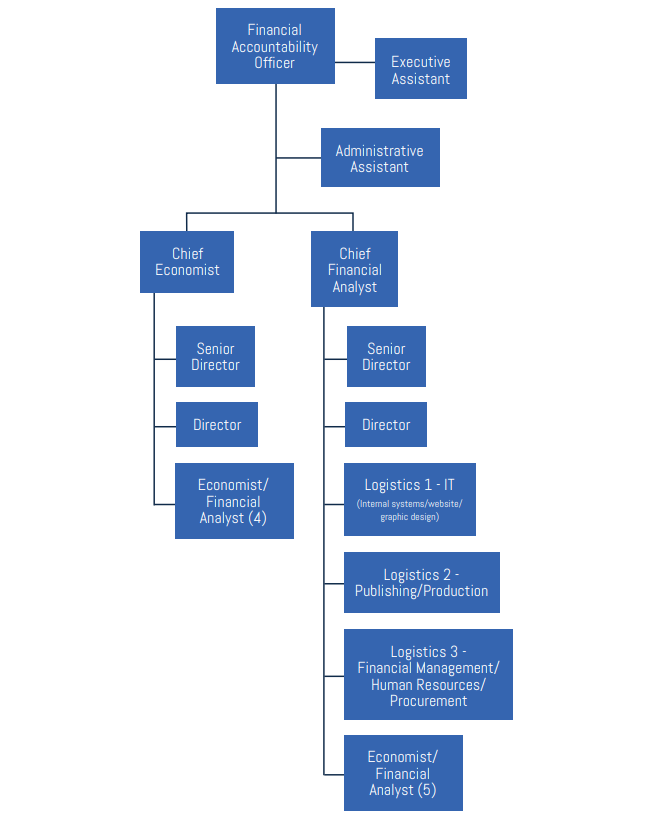
Note: This organizational chart was prepared for planning purposes and does not reflect the current composition of the FAO’s staff.
Accessible version
- Financial Accountability Officer
- Executive Assistant
- Administrative Assistant
- Chief Economist
- Senior Director
- Director
- Economist/ Financial Analyst (4)
- Chief Financial Analyst
- Senior Director
- Director
- Logistics 1 – IT (Internal systems/website/ graphic design)
- Logistics 2 – Publishing/Production
- Logistics 3 – Financial Management/ Human Resources/ Procurement
- Economist/ Financial Analyst (4)
Footnotes
[1] Based on Page, K., External Review of the Office of Budget Responsibility, 2014 (http://budgetresponsibility.org.uk/wordpress/docs/External_review_2014.pdf).