

Summary
- This report describes Ontario’s recent economic performance based on the latest economic indicators.
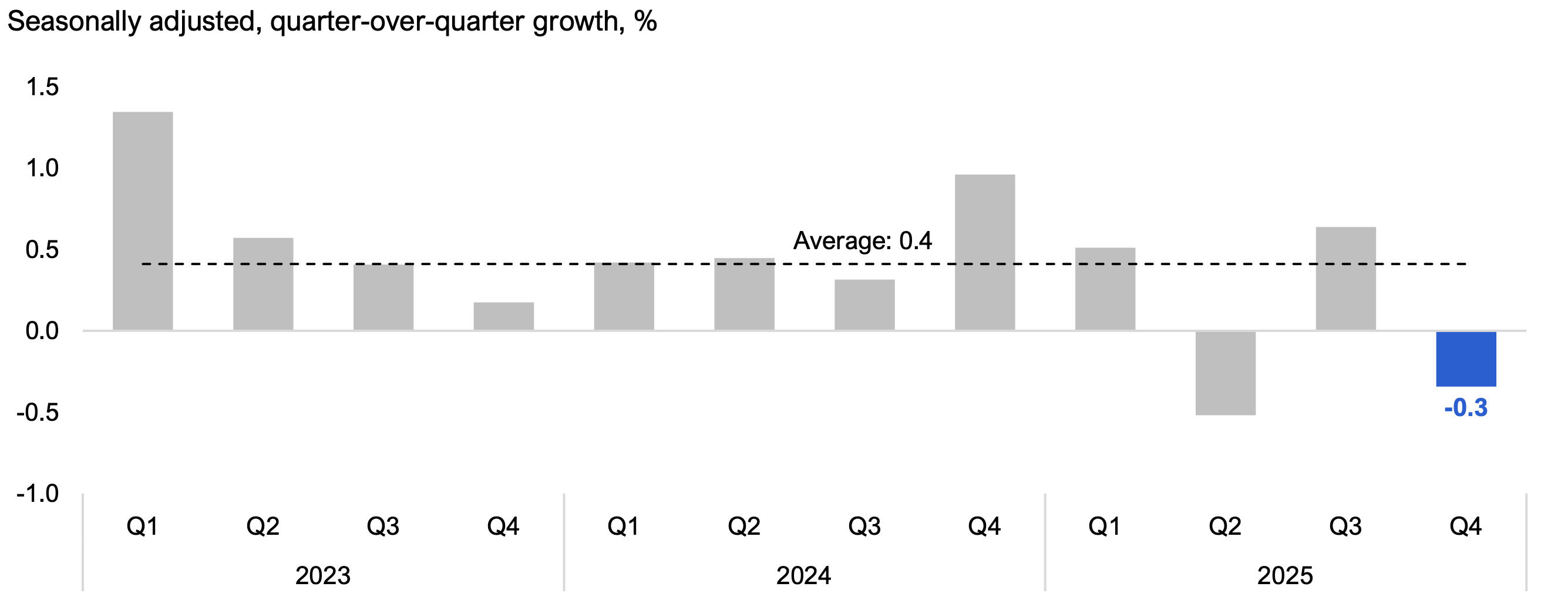
- In the fourth quarter of 2025, Ontario’s real Gross Domestic Product (GDP), the broadest measure of economic activity, decreased by 0.3%, marking the second decline in the past three quarters. The decline in 2025 Q4 largely resulted from a draw-down in inventories and, to a lesser extent, a reduction in residential investment. These declines were partially offset by increases in household and government consumption, government investment and an improvement in net trade.
- The latest economic indicators suggest Ontario’s economy was little changed in the first quarter of 2026, with strong gains in retail sales and wholesale trade tempered by employment losses, slower housing market activity, a decline in the net trade of international goods, and lower manufacturing sales.
- Looking ahead to the full year, the FAO’s latest Economic and Budget Outlook,[1] released in February 2026, projected that Ontario’s annual real GDP would rise by 1.4% in 2026, while consumer price inflation was expected to be 2.1%. Recent economic data and global events, including a decline in Ontario’s population and the dramatic increase in the price of oil, have put downside pressure on the FAO’s projection for 2026 real GDP growth, and upside pressure on the FAO’s projection for 2026 consumer price inflation.
Introduction and Background
The Ontario Economic Monitor presents an overview of the latest trends in the Ontario economy based on the most recent economic data as of May 22, 2026.
Each quarter, the Government of Ontario (the Province) releases the Ontario Economic Accounts (OEA), which provides data on GDP, a comprehensive measure of economic activity in Ontario. The OEA is produced by the Ontario Ministry of Finance and released approximately four months after the quarter closes.[2] The OEA is available on the Province’s Ontario Economic Accounts website.
In addition, Statistics Canada and other organizations produce many monthly economic indicators that provide insight into Ontario’s economy. These form part of the underlying data used to produce the OEA. This report focuses on these indicators, which are typically released one to two months after the data are collected, and provides more up-to-date information on Ontario’s economic performance in the most recent quarter.[3]
The report contains the following sections:
- a summary of the OEA describing the province’s economic performance in the fourth quarter of 2025 (2025 Q4);
- a summary of the most recent monthly economic indicators for Ontario’s households and businesses in 2026 Q1; and
- an assessment of the FAO’s latest economic outlook based on recent economic trends and geopolitical events.
For definitions of the economic indicators covered in this report, as well as technical definitions of economic concepts, see the report’s Glossary. For information on the data used, see the report’s Methodology.
2025 Fourth Quarter Ontario Economic Accounts
The Ontario Economic Accounts (OEA) for the fourth quarter (October to December) of 2025 was released on April 10, 2026. The OEA provides a comprehensive assessment of Ontario’s recent economic performance.
Real Gross Domestic Product (GDP), the broadest measure of economic activity, decreased by 0.3% in 2025 Q4, marking the second decline in the past three quarters. The decrease in overall economic activity largely resulted from a draw-down in inventories[4] and, to a lesser extent, a reduction in residential investment (-3.5%). These declines were partially offset by increases in household (0.6%) and government consumption (0.6%), government investment (3.7%) and an improvement in net trade.[5]
Figure 1 Real GDP decreased by 0.3% in 2025 Q4
Source: Ontario Economic Accounts and FAO.
Accessible version
| Seasonally adjusted, quarter-over-quarter growth, % | Average | |
|---|---|---|
| 2023 Q1 | 1.3 | 0.4 |
| 2023 Q2 | 0.6 | 0.4 |
| 2023 Q3 | 0.4 | 0.4 |
| 2023 Q4 | 0.2 | 0.4 |
| 2024 Q1 | 0.4 | 0.4 |
| 2024 Q2 | 0.4 | 0.4 |
| 2024 Q3 | 0.3 | 0.4 |
| 2024 Q4 | 1.0 | 0.4 |
| 2025 Q1 | 0.5 | 0.4 |
| 2025 Q2 | -0.5 | 0.4 |
| 2025 Q3 | 0.6 | 0.4 |
| 2025 Q4 | -0.3 | 0.4 |
For the year as a whole, Ontario’s real GDP grew by 1.3% in 2025 led by increases in household expenditure (2.3%), government spending (2.9%), non-residential investment (2.2%) and government capital expenditure (7.0%). Growth was held back by declines in residential investment (-4.1%), machinery and equipment investment (-5.8%) and exports (‑0.6%).
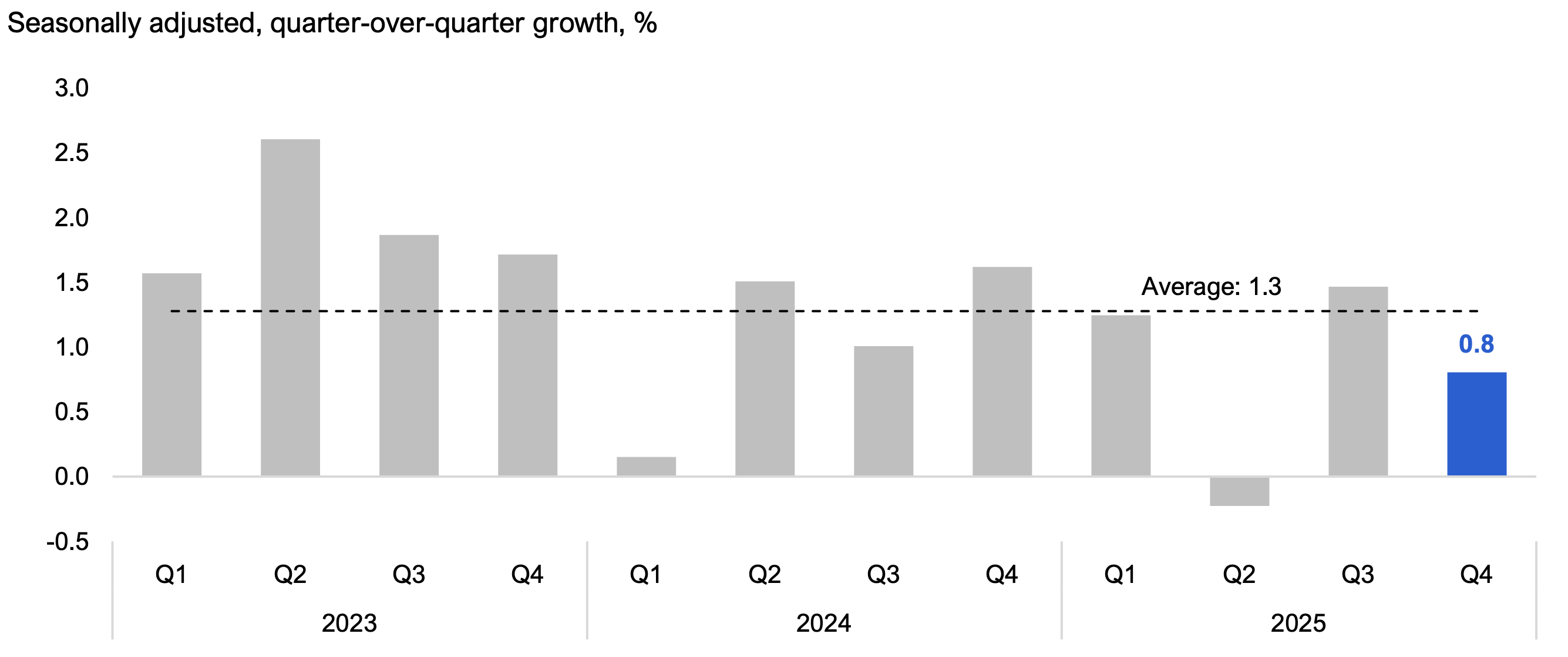
On an income basis,[6] nominal GDP, the broadest measure of the tax base and which includes inflation, increased by 0.8% in 2025 Q4, slowing from a gain of 1.5% in the previous quarter. The growth in nominal GDP reflected gains in labour income (0.7%), corporate profits (1.8%) and unincorporated business income (1.7%), partially offset by a decline in all other sources of income[7] (-0.6%).
Figure 2 Nominal GDP increased by 0.8% in 2025 Q4
Source: Ontario Economic Accounts and FAO.
Accessible version
| Seasonally adjusted, quarter-over-quarter growth, % | Average | |
|---|---|---|
| 2023 Q1 | 1.6 | 1.3 |
| 2023 Q2 | 2.6 | 1.3 |
| 2023 Q3 | 1.9 | 1.3 |
| 2023 Q4 | 1.7 | 1.3 |
| 2024 Q1 | 0.2 | 1.3 |
| 2024 Q2 | 1.5 | 1.3 |
| 2024 Q3 | 1.0 | 1.3 |
| 2024 Q4 | 1.6 | 1.3 |
| 2025 Q1 | 1.2 | 1.3 |
| 2025 Q2 | -0.2 | 1.3 |
| 2025 Q3 | 1.5 | 1.3 |
| 2025 Q4 | 0.8 | 1.3 |
For the year as a whole, Ontario’s nominal GDP grew by 4.2% in 2025, reflecting gains in labour income (3.8%), corporate profits (5.8%), unincorporated business income (7.6%) and all other sources of income (3.2%).
For more detailed information on Ontario’s economic performance in 2025 Q4, see the Ontario Economic Accounts.
Ontario’s 2026 First Quarter Economic Indicators
The latest economic indicators suggest Ontario’s economy was little changed in the first quarter of 2026, with strong gains in retail sales and wholesale trade tempered by employment losses, slower housing market activity, a decline in the net trade of international goods and lower manufacturing sales.
Households
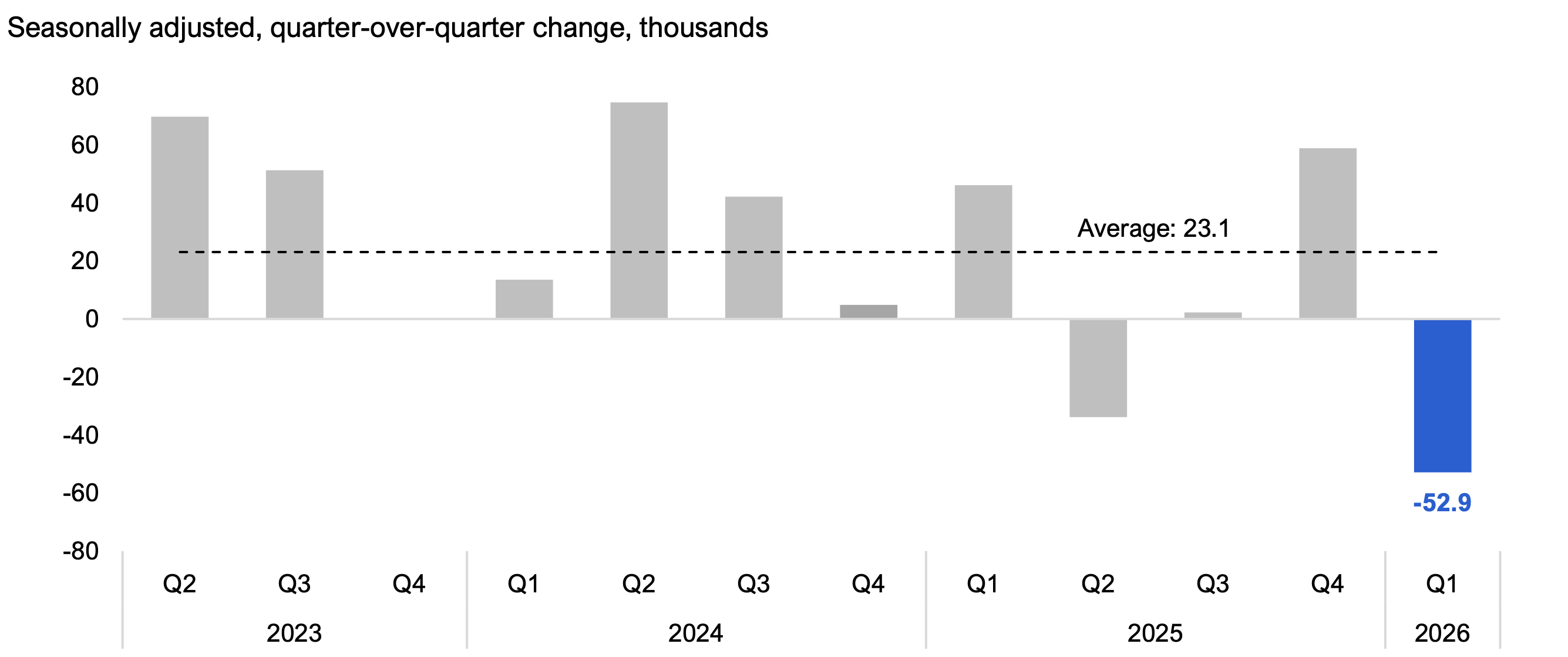
Employment in Ontario decreased by a significant 52,900 jobs (or -0.6%) in 2026 Q1, after an increase of 58,900 jobs in the previous quarter. This marked the steepest quarterly job loss since early 2009, excluding the pandemic. In the first quarter, employment decreased in both full-time (-23,300) and part-time (-29,600) positions. Job losses were concentrated in the private sector (-70,400), partially offset by small gains in both the public sector (7,500) and self-employment (10,000).[8]
Figure 3 Employment decreased by 52,900 jobs in 2026 Q1
Source: Statistics Canada Table 14-10-0287-01 and FAO.
Accessible version
| Seasonally adjusted, quarter-over-quarter change, thousands | Average | |
|---|---|---|
| 2023 Q2 | 69.7 | 23.1 |
| 2023 Q3 | 51.3 | 23.1 |
| 2023 Q4 | 0.1 | 23.1 |
| 2024 Q1 | 13.5 | 23.1 |
| 2024 Q2 | 74.6 | 23.1 |
| 2024 Q3 | 42.2 | 23.1 |
| 2024 Q4 | 4.9 | 23.1 |
| 2025 Q1 | 46.1 | 23.1 |
| 2025 Q2 | -33.8 | 23.1 |
| 2025 Q3 | 2.3 | 23.1 |
| 2025 Q4 | 58.9 | 23.1 |
| 2026 Q1 | -52.9 | 23.1 |
All major age groups saw job losses in 2026 Q1, with youth employment (aged 15 to 24) decreasing by 33,400 jobs and core-age employment (aged 25 to 54) declining by 13,100 jobs. Employment of workers aged 55 and older fell by 6,400 jobs.
Ontario saw employment losses across several major industries in 2026 Q1, with the largest losses recorded in manufacturing (-31,100); professional, scientific and technical services (-16,400); wholesale and retail trade (‑13,300); accommodation and food services (-13,200); and educational services (-7,400).[9] These were partially offset by gains in other industries, including business, building and other support services (11,500); health care and social assistance (3,700); forestry, fishing, mining, quarrying, oil and gas (3,300); and public administration (3,100).
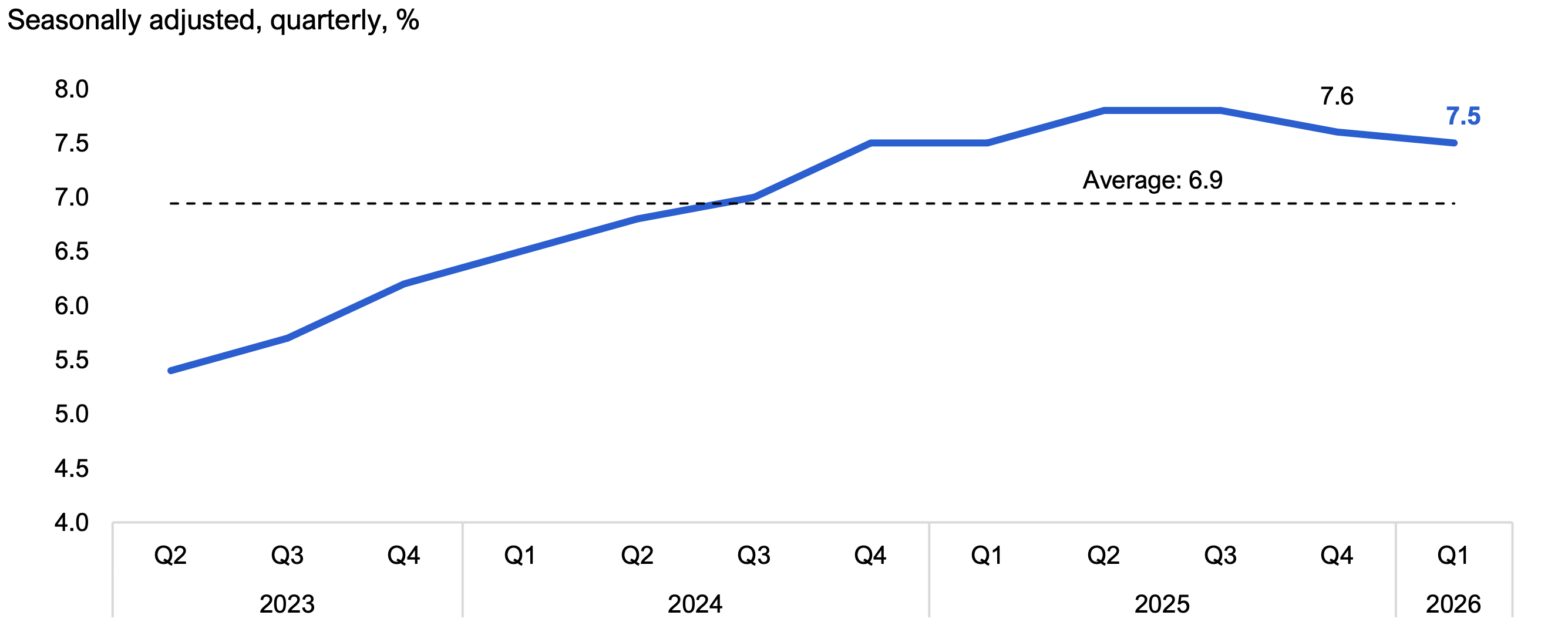
Ontario’s labour force dropped by a significant 71,300 in 2026 Q1, a decline of 0.8% and the sharpest decline on record back to 1976, excluding the pandemic. With the number of people exiting the labour force exceeding the loss of jobs, Ontario’s unemployment rate declined by 0.1 percentage points in 2026 Q1 to 7.5%. The unemployment rate declined for both core-age (aged 25 to 54) workers (from 6.7% to 6.6%) and workers aged 55 years and over (from 5.3% to 4.7%) in 2026 Q1, while the youth (aged 15 to 24) unemployment rate increased 0.3 percentage points to 15.9%.
Ontario workers continue to have a difficult time finding employment as job vacancies have trended lower. In 2026 Q1, long-term unemployment[10] accounted for 28.2% of total unemployment, up from 27.8% in 2025 Q4, and the second highest reading since 1996, excluding the pandemic.
Figure 4 Unemployment rate declined to 7.5% in 2026 Q1
Source: Statistics Canada Table 14-10-0287-01 and FAO.
Accessible version
| Seasonally adjusted, quarterly, % | Average | |
|---|---|---|
| 2023 Q2 | 5.4 | 6.9 |
| 2023 Q3 | 5.7 | 6.9 |
| 2023 Q4 | 6.2 | 6.9 |
| 2024 Q1 | 6.5 | 6.9 |
| 2024 Q2 | 6.8 | 6.9 |
| 2024 Q3 | 7.0 | 6.9 |
| 2024 Q4 | 7.5 | 6.9 |
| 2025 Q1 | 7.5 | 6.9 |
| 2025 Q2 | 7.8 | 6.9 |
| 2025 Q3 | 7.8 | 6.9 |
| 2025 Q4 | 7.6 | 6.9 |
| 2026 Q1 | 7.5 | 6.9 |
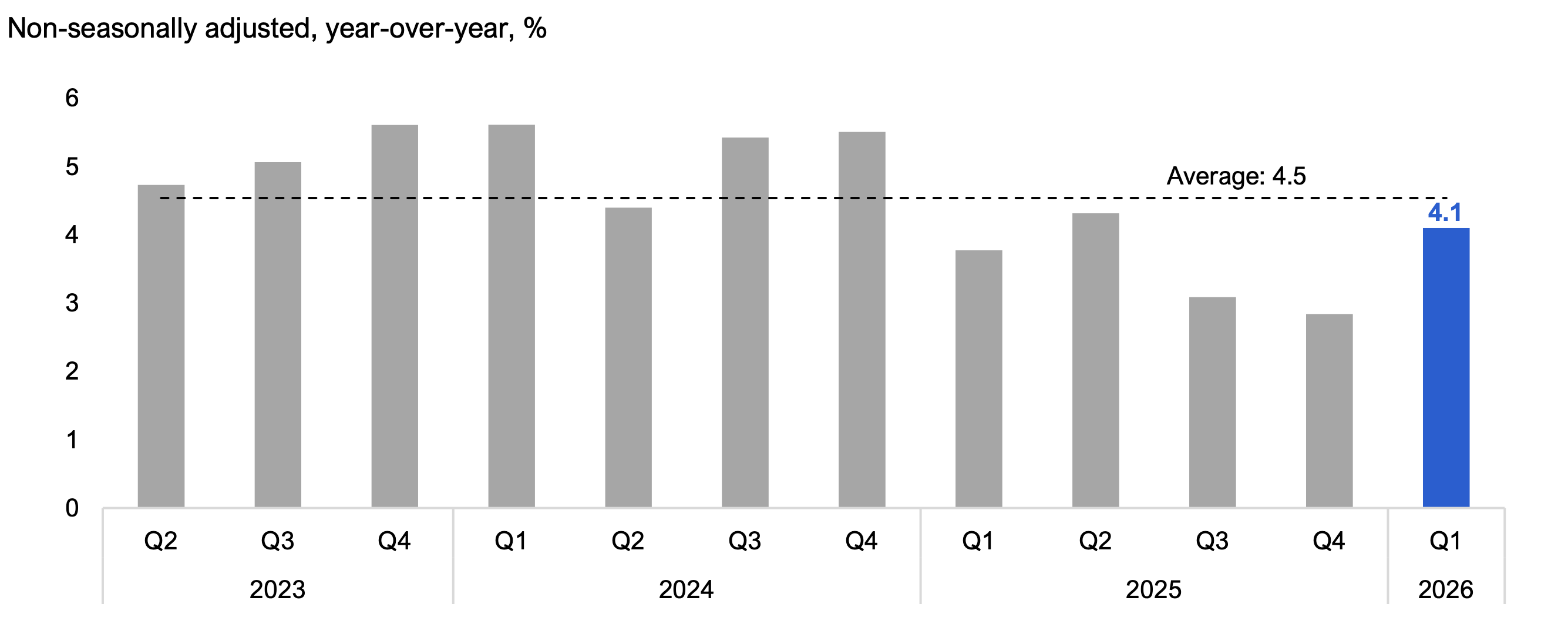
Average hourly wages grew 4.1% in 2026 Q1 compared to 2025 Q1, reaching $38.85 an hour. The acceleration in average hourly wages in the first quarter came after two quarters of slower wage gains. Hourly wage growth was broad-based across most major industries, with wages in goods-producing industries rising 5.0% and services-producing industries rising 3.9%. Industries with the fastest wage growth included finance, insurance and real estate; wholesale and retail trade; business, building and other support services; and manufacturing.
Figure 5 Average hourly wages grew 4.1% in 2026 Q1
Source: Statistics Canada Table 14-10-0063-01 and FAO.
Accessible version
| Non-seasonally adjusted, year-over-year, % | Average | |
|---|---|---|
| 2023 Q2 | 4.7 | 4.5 |
| 2023 Q3 | 5.1 | 4.5 |
| 2023 Q4 | 5.6 | 4.5 |
| 2024 Q1 | 5.6 | 4.5 |
| 2024 Q2 | 4.4 | 4.5 |
| 2024 Q3 | 5.4 | 4.5 |
| 2024 Q4 | 5.5 | 4.5 |
| 2025 Q1 | 3.8 | 4.5 |
| 2025 Q2 | 4.3 | 4.5 |
| 2025 Q3 | 3.1 | 4.5 |
| 2025 Q4 | 2.8 | 4.5 |
| 2026 Q1 | 4.1 | 4.5 |
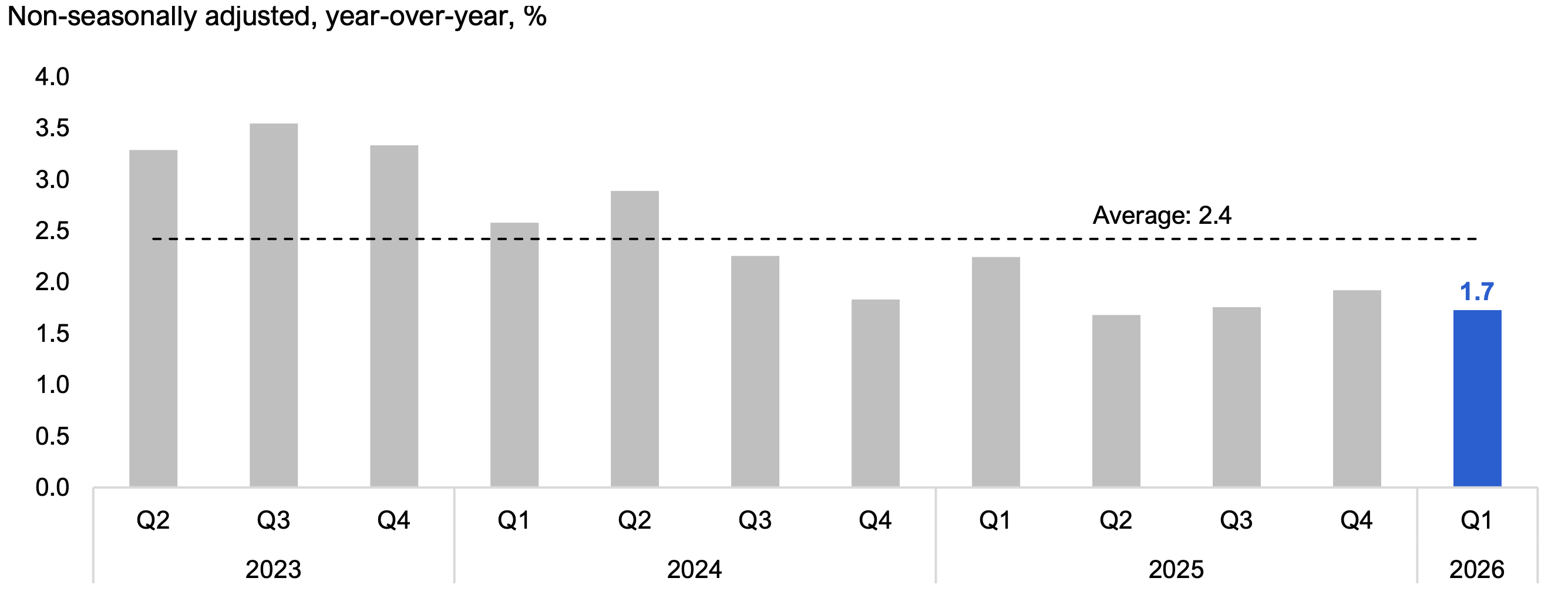
The Ontario Consumer Price Index (CPI) inflation rate[11] was 1.7% in 2026 Q1, lower than the 1.9% rate recorded in 2025 Q4. Of the major CPI components, food inflation was a significant contributor (6.8%) in 2026 Q1. Other categories that grew faster than the headline inflation rate in 2026 Q1 were alcohol and tobacco (3.9%), health and personal care (2.6%), and recreation and reading (2.0%). In contrast, household operations (0.9%), transportation (0.3%), clothing and footwear (0.2%), and shelter prices (0.0%) all grew slower than overall inflation. The last time shelter inflation was this low occurred in late 2009 and early 2010, just after the global financial crisis.
Despite the significant increase in oil prices starting in March due to the war in Iran, energy prices were 6.5% lower in 2026 Q1 than a year earlier, reflecting in part the removal of the Canada consumer carbon tax. Excluding energy, the inflation rate was 2.3% in 2026 Q1, 0.6 percentage points above the all-items inflation rate of 1.7%. The sharp rise in oil prices since the start of the war in Iran is expected to boost inflation in 2026 Q2.
Figure 6 CPI inflation rate was 1.7% in 2026 Q1
Source: Statistics Canada Table 18-10-0004-01 and FAO.
Accessible version
| Non-seasonally adjusted, year-over-year, % | Average | |
|---|---|---|
| 2023 Q2 | 3.3 | 2.4 |
| 2023 Q3 | 3.5 | 2.4 |
| 2023 Q4 | 3.3 | 2.4 |
| 2024 Q1 | 2.6 | 2.4 |
| 2024 Q2 | 2.9 | 2.4 |
| 2024 Q3 | 2.3 | 2.4 |
| 2024 Q4 | 1.8 | 2.4 |
| 2025 Q1 | 2.2 | 2.4 |
| 2025 Q2 | 1.7 | 2.4 |
| 2025 Q3 | 1.8 | 2.4 |
| 2025 Q4 | 1.9 | 2.4 |
| 2026 Q1 | 1.7 | 2.4 |
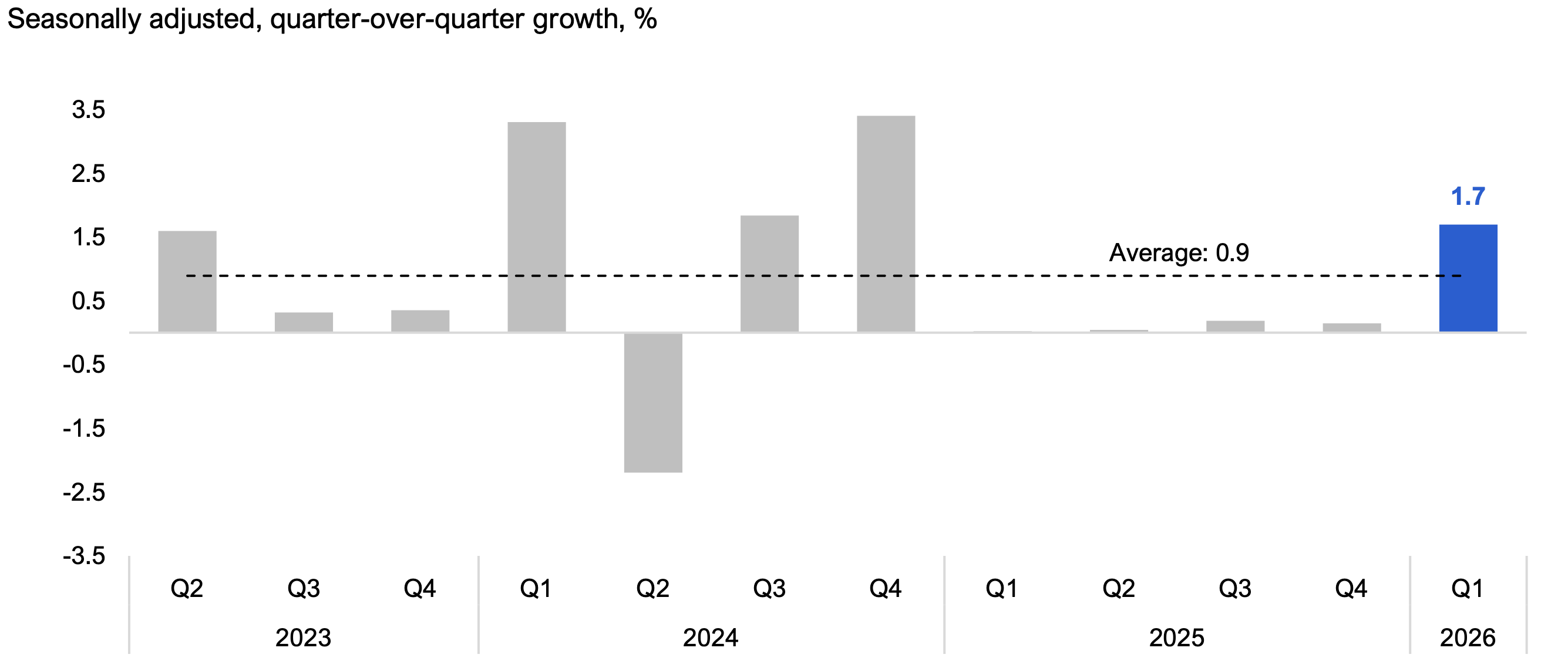
Retail sales increased by 1.7% in 2026 Q1 in Ontario, after four quarters of prolonged weakness. High prices and economic uncertainty continue to impact consumer spending, though concerns about US-Canada trade tensions have diminished somewhat.[12] Growth in retail sales in 2026 Q1 was driven by health and personal care; food and beverages; and gasoline and fuel sales, which more than offset declines in furniture and appliances; and building materials.
Figure 7 Retail sales increased by 1.7% in 2026 Q1
Source: Statistics Canada Table 20-10-0056-01 and FAO.
Accessible version
| Seasonally adjusted, quarter-over-quarter growth, % | Average | |
|---|---|---|
| 2023 Q2 | 1.6 | 0.9 |
| 2023 Q3 | 0.3 | 0.9 |
| 2023 Q4 | 0.4 | 0.9 |
| 2024 Q1 | 3.3 | 0.9 |
| 2024 Q2 | -2.2 | 0.9 |
| 2024 Q3 | 1.8 | 0.9 |
| 2024 Q4 | 3.4 | 0.9 |
| 2025 Q1 | 0.0 | 0.9 |
| 2025 Q2 | 0.0 | 0.9 |
| 2025 Q3 | 0.2 | 0.9 |
| 2025 Q4 | 0.1 | 0.9 |
| 2026 Q1 | 1.7 | 0.9 |
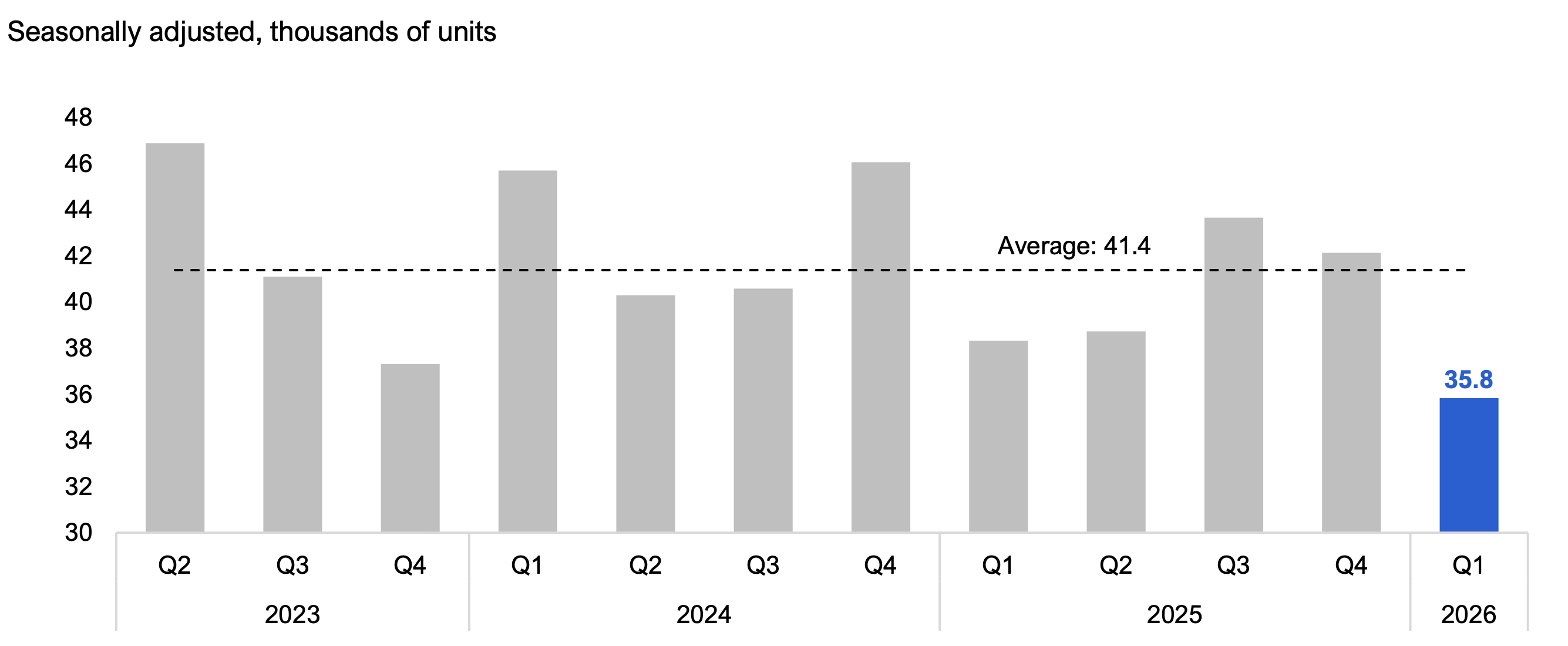
Ontario home resales in 2026 Q1 totalled 35,800 units, a decrease of 14.9% from the previous quarter. This marked the second consecutive quarterly decline following a 3.5% decline in 2025 Q4. The level of sales in 2026 Q1 was the lowest since early 2009, excluding the pandemic. Unusually harsh winter weather contributed to lower home resales in 2026 Q1.
Figure 8 Housing resales declined to 35,800 units in 2026 Q1
Source: Canadian Real Estate Association and FAO.
Accessible version
| Seasonally adjusted, thousands of units | Average | |
|---|---|---|
| 2023 Q2 | 46.9 | 41.4 |
| 2023 Q3 | 41.1 | 41.4 |
| 2023 Q4 | 37.3 | 41.4 |
| 2024 Q1 | 45.7 | 41.4 |
| 2024 Q2 | 40.3 | 41.4 |
| 2024 Q3 | 40.6 | 41.4 |
| 2024 Q4 | 46.0 | 41.4 |
| 2025 Q1 | 38.3 | 41.4 |
| 2025 Q2 | 38.7 | 41.4 |
| 2025 Q3 | 43.6 | 41.4 |
| 2025 Q4 | 42.1 | 41.4 |
| 2026 Q1 | 35.8 | 41.4 |
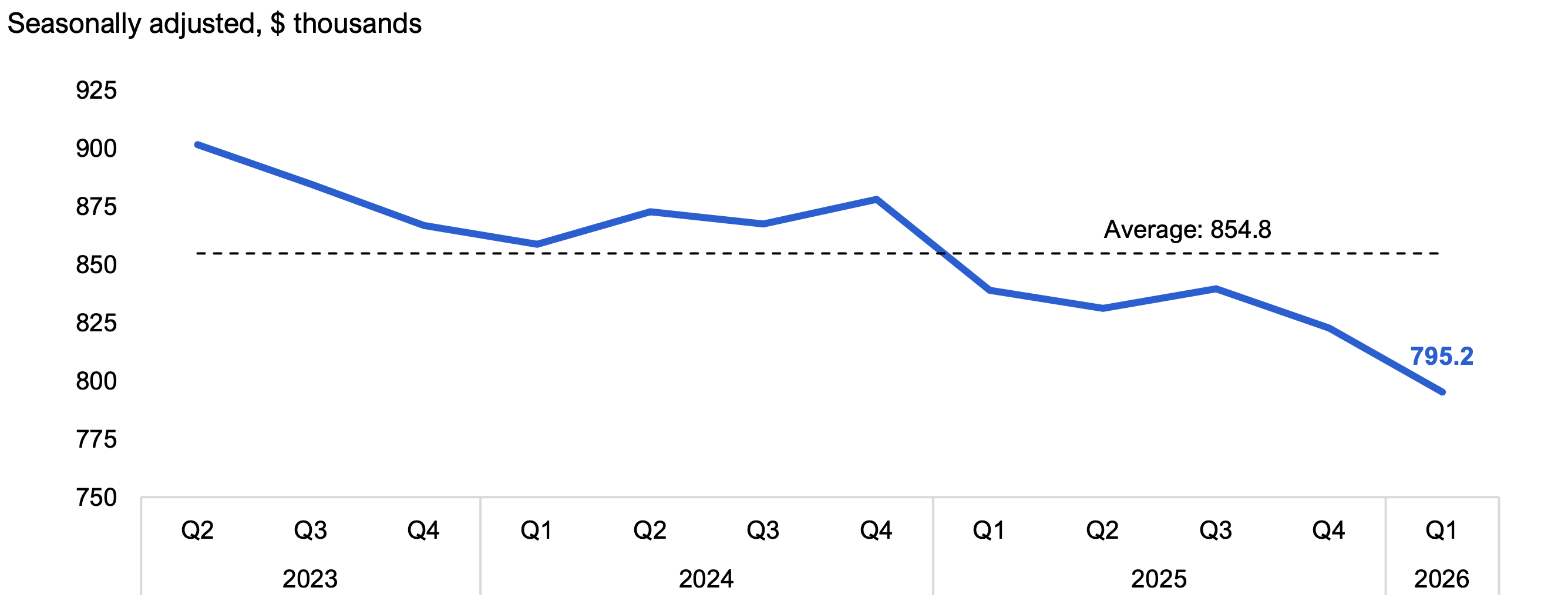
Home resale prices in Ontario averaged $795,200 in 2026 Q1, a 3.3% decline from the previous quarter. In 2026 Q1, the average resale home price was $243,200 (or ‑23.5%) below the peak reached in 2022 Q1 ($1,038,900), but $134,800 (or 20.4%) above the pre-pandemic average resale home price in 2020 Q1 ($660,400).
Figure 9 Average home resale prices declined to $795,200 in 2026 Q1
Source: Canadian Real Estate Association and FAO.
Accessible version
| Seasonally adjusted, $ thousands | Average | |
|---|---|---|
| 2023 Q2 | 901.6 | 854.8 |
| 2023 Q3 | 884.6 | 854.8 |
| 2023 Q4 | 866.8 | 854.8 |
| 2024 Q1 | 858.7 | 854.8 |
| 2024 Q2 | 872.8 | 854.8 |
| 2024 Q3 | 867.5 | 854.8 |
| 2024 Q4 | 878.0 | 854.8 |
| 2025 Q1 | 838.9 | 854.8 |
| 2025 Q2 | 831.2 | 854.8 |
| 2025 Q3 | 839.6 | 854.8 |
| 2025 Q4 | 822.7 | 854.8 |
| 2026 Q1 | 795.2 | 854.8 |
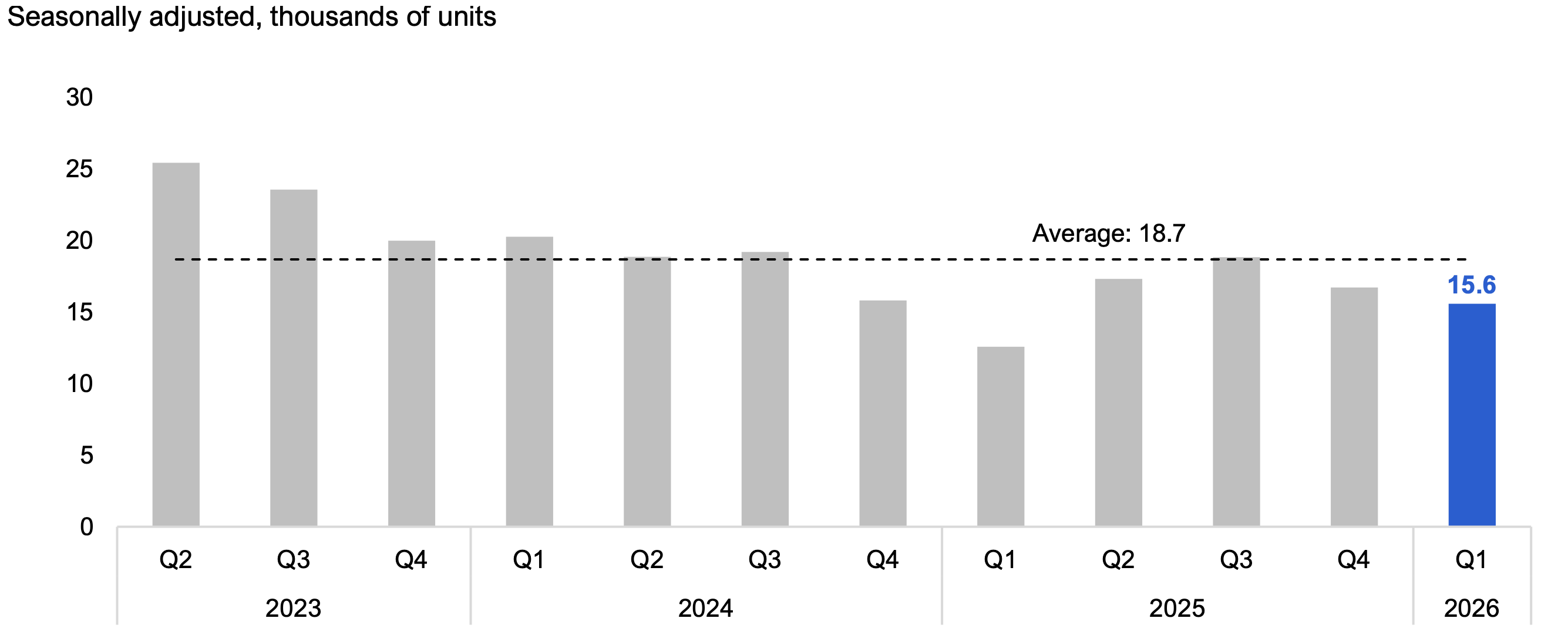
Housing starts[13] in 2026 Q1 totalled 15,600 units in Ontario, a decline of 6.8% from 2025 Q4. This marked the second consecutive quarterly decline, following an 11.2% drop in 2025 Q4. In 2026 Q1, 84% of total housing starts were multiple unit dwellings, while 16% were single detached homes.[14]
Figure 10 Housing starts fell to 15,600 units in 2026 Q1
Source: Statistics Canada Table 34-10-0141-01 and FAO.
Accessible version
| Seasonally adjusted, thousands of units | Average | |
|---|---|---|
| 2023 Q2 | 25.4 | 18.7 |
| 2023 Q3 | 23.5 | 18.7 |
| 2023 Q4 | 20.0 | 18.7 |
| 2024 Q1 | 20.2 | 18.7 |
| 2024 Q2 | 18.9 | 18.7 |
| 2024 Q3 | 19.2 | 18.7 |
| 2024 Q4 | 15.8 | 18.7 |
| 2025 Q1 | 12.6 | 18.7 |
| 2025 Q2 | 17.3 | 18.7 |
| 2025 Q3 | 18.8 | 18.7 |
| 2025 Q4 | 16.7 | 18.7 |
| 2026 Q1 | 15.6 | 18.7 |
Businesses
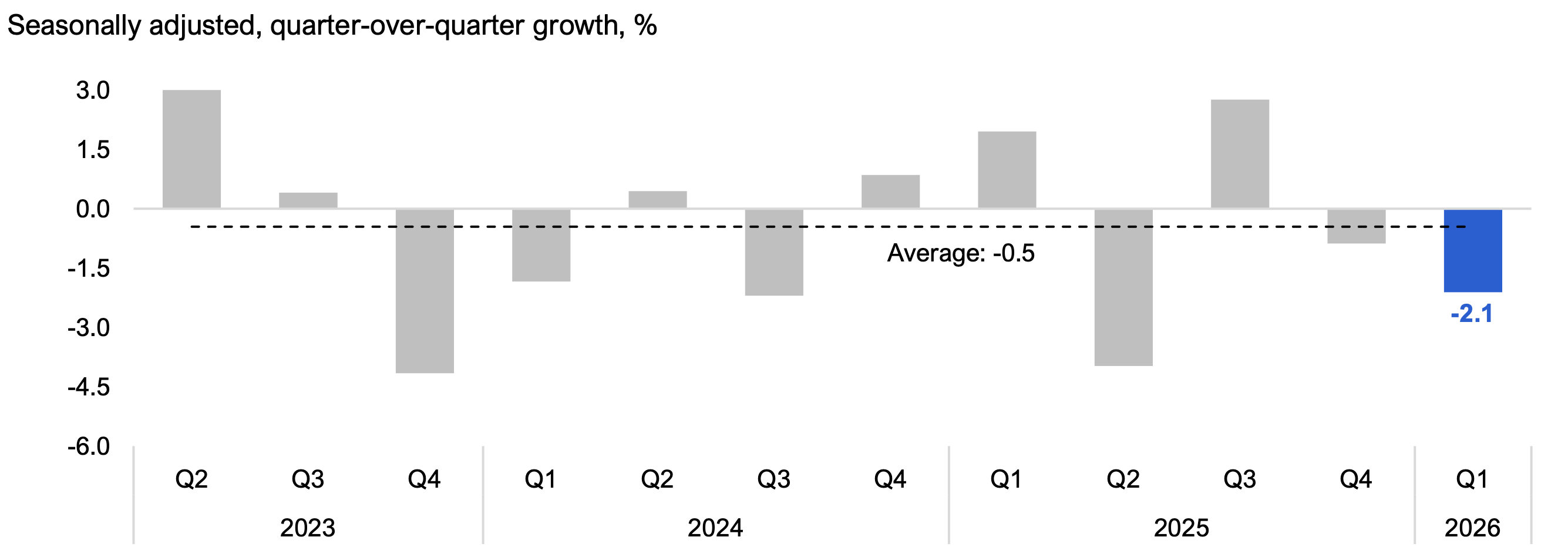
Manufacturing sales declined by 2.1% in 2026 Q1, following a 0.9% decrease in 2025 Q4. The decline resulted primarily from lower sales of motor vehicles (-13.3%) and machinery (-4.8%). Manufacturing sales have struggled over the last several years, declining in six of the past 10 quarters, by a total of 9.0% since mid-2023. The weakness since 2023 reflects reduced activity in auto assembly for retooling and the impact of US tariffs.
Figure 11 Manufacturing sales declined by 2.1% in 2026 Q1
Source: Statistics Canada Table 16-10-0048-01 and FAO.
Accessible version
| Seasonally adjusted, quarter-over-quarter growth, % | Average | |
|---|---|---|
| 2023 Q2 | 3.3 | -0.5 |
| 2023 Q3 | 0.4 | -0.5 |
| 2023 Q4 | -4.2 | -0.5 |
| 2024 Q1 | -1.8 | -0.5 |
| 2024 Q2 | 0.4 | -0.5 |
| 2024 Q3 | -2.2 | -0.5 |
| 2024 Q4 | 0.9 | -0.5 |
| 2025 Q1 | 2.0 | -0.5 |
| 2025 Q2 | -4.0 | -0.5 |
| 2025 Q3 | 2.8 | -0.5 |
| 2025 Q4 | -0.9 | -0.5 |
| 2026 Q1 | -2.1 | -0.5 |
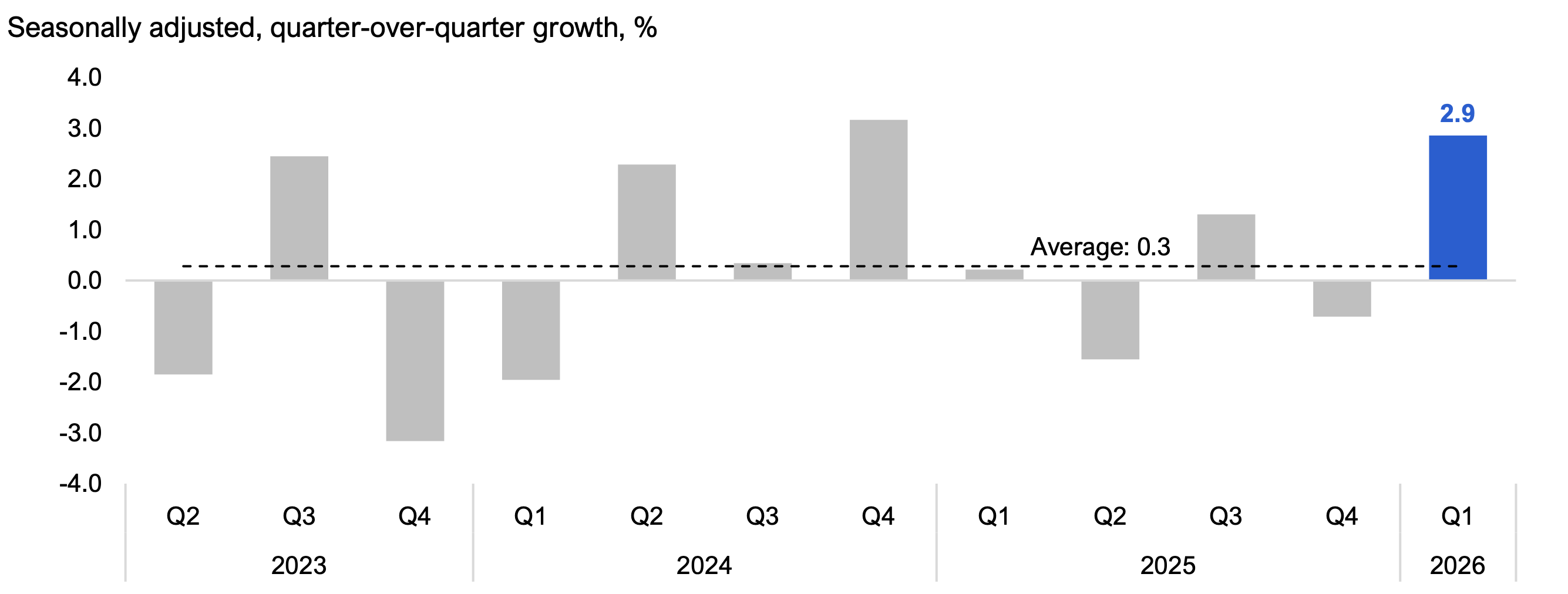
Wholesale trade, which measures sales of bulk items to retailers and businesses, increased by 2.9% in 2026 Q1, following a 0.7% decline in the previous quarter. The 2026 Q1 increase was largely the result of growth in personal and household goods (4.3%), motor vehicles and parts (2.9%), petroleum and petroleum products (10.2%) and machinery and equipment (2.5%).
Figure 12 Wholesale trade increased by 2.9% in 2026 Q1
Source: Statistics Canada Table 20-10-0074-01 and FAO.
Accessible version
| Seasonally adjusted, quarter-over-quarter growth, % | Average | |
|---|---|---|
| 2023 Q2 | -1.9 | 0.3 |
| 2023 Q3 | 2.4 | 0.3 |
| 2023 Q4 | -3.2 | 0.3 |
| 2024 Q1 | -2.0 | 0.3 |
| 2024 Q2 | 2.3 | 0.3 |
| 2024 Q3 | 0.3 | 0.3 |
| 2024 Q4 | 3.2 | 0.3 |
| 2025 Q1 | 0.2 | 0.3 |
| 2025 Q2 | -1.6 | 0.3 |
| 2025 Q3 | 1.3 | 0.3 |
| 2025 Q4 | -0.7 | 0.3 |
| 2026 Q1 | 2.9 | 0.3 |
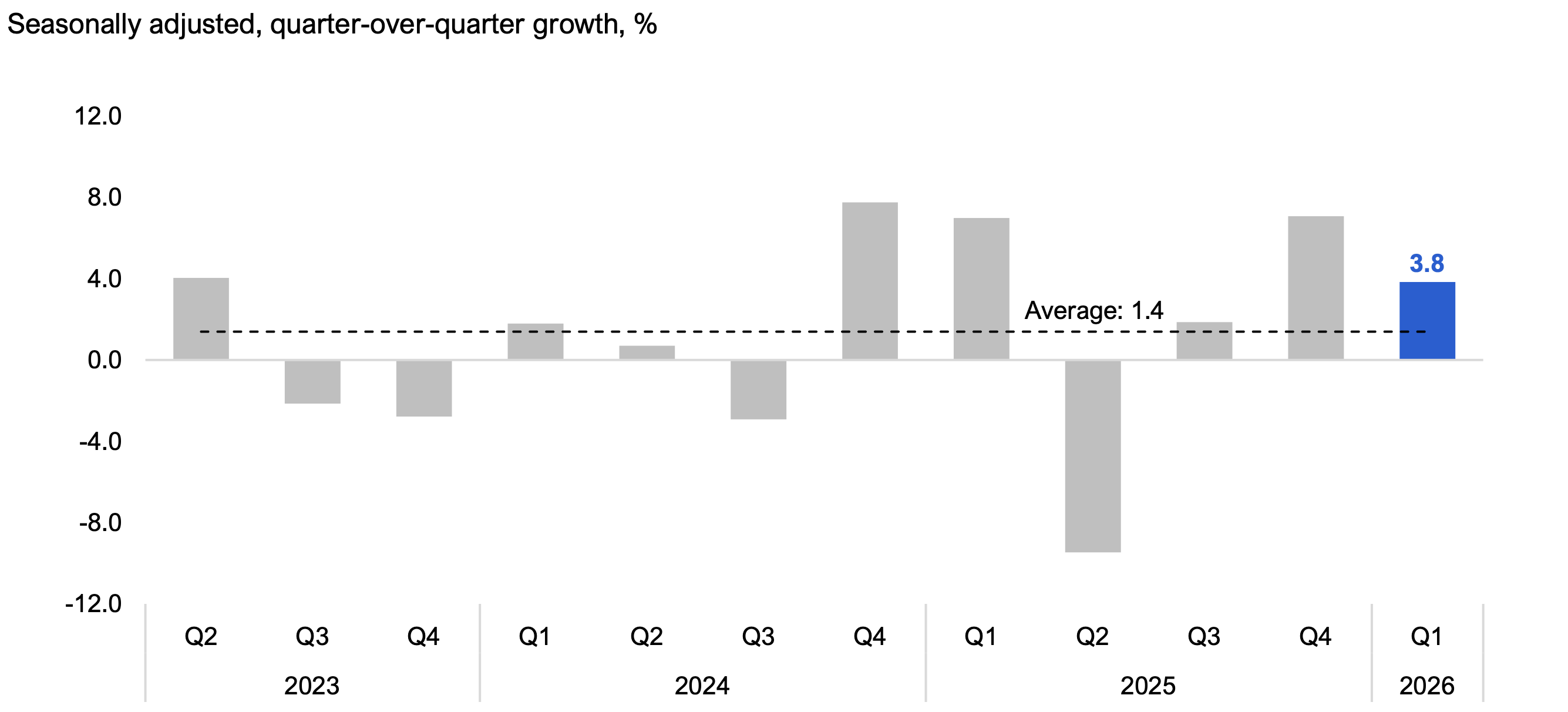
International merchandise exports, which accounts for all goods leaving the country through Ontario, increased by 3.8% in 2026 Q1, moderating from growth of 7.1% in the previous quarter. The increase in the first quarter was largely attributed to a rise in exports of metal and non-metallic mineral products, energy products, and aircraft and other transportation equipment and parts, partially offset by weakness in motor vehicles and parts, consumer goods, and forestry products.
Figure 13 International merchandise exports increased 3.8% in 2026 Q1
Source: Statistics Canada Table 12-10-0175-01, Table 12-10-0163-01 and FAO estimate.
Accessible version
| Seasonally adjusted, quarter-over-quarter growth, % | Average | |
|---|---|---|
| 2023 Q2 | 4.0 | 1.4 |
| 2023 Q3 | -2.1 | 1.4 |
| 2023 Q4 | -2.8 | 1.4 |
| 2024 Q1 | 1.8 | 1.4 |
| 2024 Q2 | 0.7 | 1.4 |
| 2024 Q3 | -2.9 | 1.4 |
| 2024 Q4 | 7.8 | 1.4 |
| 2025 Q1 | 7.0 | 1.4 |
| 2025 Q2 | -9.5 | 1.4 |
| 2025 Q3 | 1.9 | 1.4 |
| 2025 Q4 | 7.1 | 1.4 |
| 2026 Q1 | 3.8 | 1.4 |
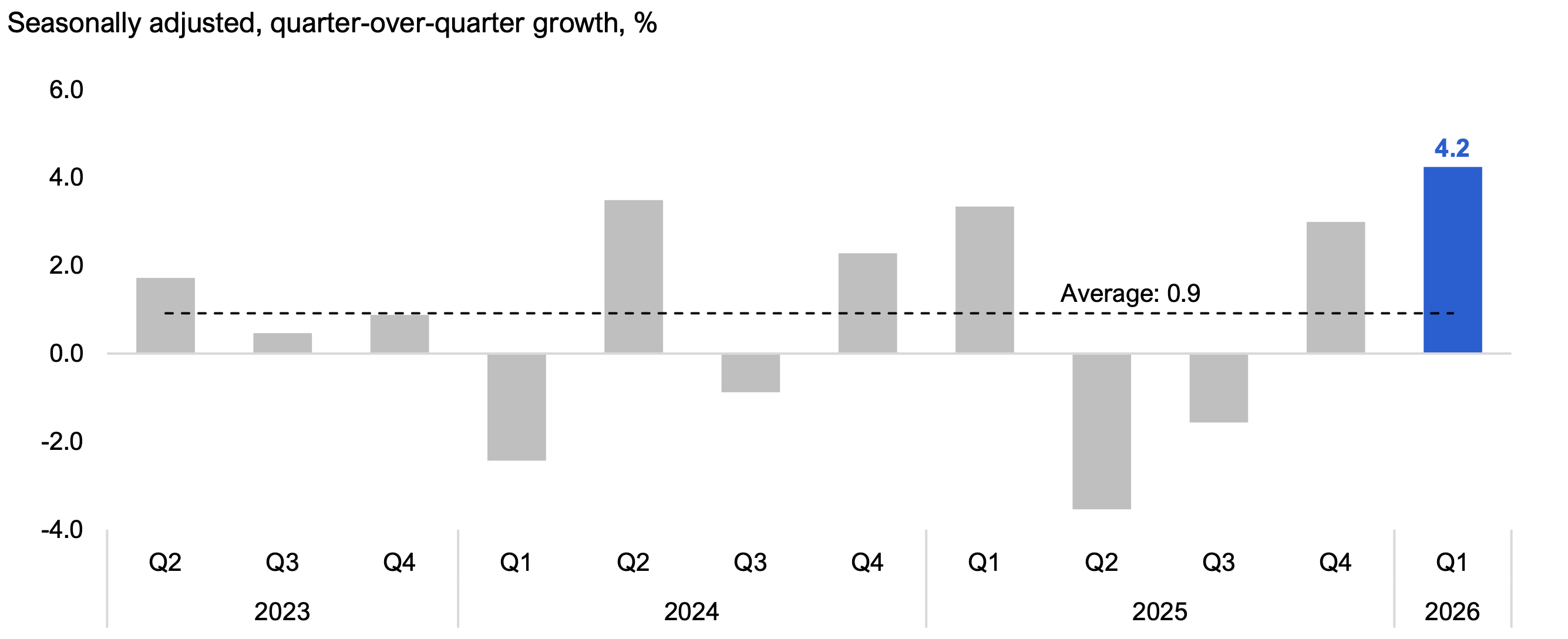
International merchandise imports, which measures international goods entering Ontario, increased by an estimated 4.2% in 2026 Q1, after a 3.0% increase the previous quarter. This was the fastest quarterly growth since 2014, excluding the pandemic. The increase largely reflected higher imports of metal and non-metallic mineral products; metal ores and non-metallic minerals; and motor vehicles and parts, partially offset by weakness in electronic and electrical equipment and parts; industrial machinery; and chemicals, plastic and rubber products.
Figure 14 International merchandise imports increased 4.2% in 2026 Q1
Source: Statistics Canada Table 12-10-0175-01, Table 12-10-0163-01 and FAO estimate.
Accessible version
| Seasonally adjusted, quarter-over-quarter growth, % | Average | |
|---|---|---|
| 2023 Q2 | 1.7 | 0.9 |
| 2023 Q3 | 0.5 | 0.9 |
| 2023 Q4 | 0.9 | 0.9 |
| 2024 Q1 | -2.4 | 0.9 |
| 2024 Q2 | 3.5 | 0.9 |
| 2024 Q3 | -0.9 | 0.9 |
| 2024 Q4 | 2.3 | 0.9 |
| 2025 Q1 | 3.3 | 0.9 |
| 2025 Q2 | -3.5 | 0.9 |
| 2025 Q3 | -1.6 | 0.9 |
| 2025 Q4 | 3.0 | 0.9 |
| 2026 Q1 | 4.2 | 0.9 |
Higher gasoline and diesel prices will raise costs for households and businesses
Since February 2026, the war in Iran has raised global oil prices significantly, with West Texas Intermediate (WTI) crude prices rising from an average of $65 US per barrel in February to $105 US per barrel in May,[15] an increase of 62%. This has in turn sharply increased the price of gasoline and diesel in Ontario. From February to May, the Ontario average price of regular unleaded gasoline increased by 58 cents per litre (44%), from $1.31/L to $1.88/L, while the average price of diesel rose by 54 cents per litre (35%), from $1.55/L to $2.10/L.[16]
If an agreement is reached to reopen the Strait of Hormuz and oil shipments begin to pick-up in June, oil prices are expected to decline to $80 US per barrel by the end of the year,[17] remaining above their pre-war prices. Assuming fuel prices in Ontario follow the same price trajectory and the demand for gasoline and diesel remains stable, Ontario households, businesses, and the government and non-profit sectors would face an additional $8.5 billion in fuel costs. Of this, an estimated $4.1 billion would be paid by households, $4.0 billion by businesses, and $0.4 billion by the government and non-profit sectors.[18]
Figure 15 Estimated increase in Ontario gasoline and diesel costs in 2026 due to the war in Iran
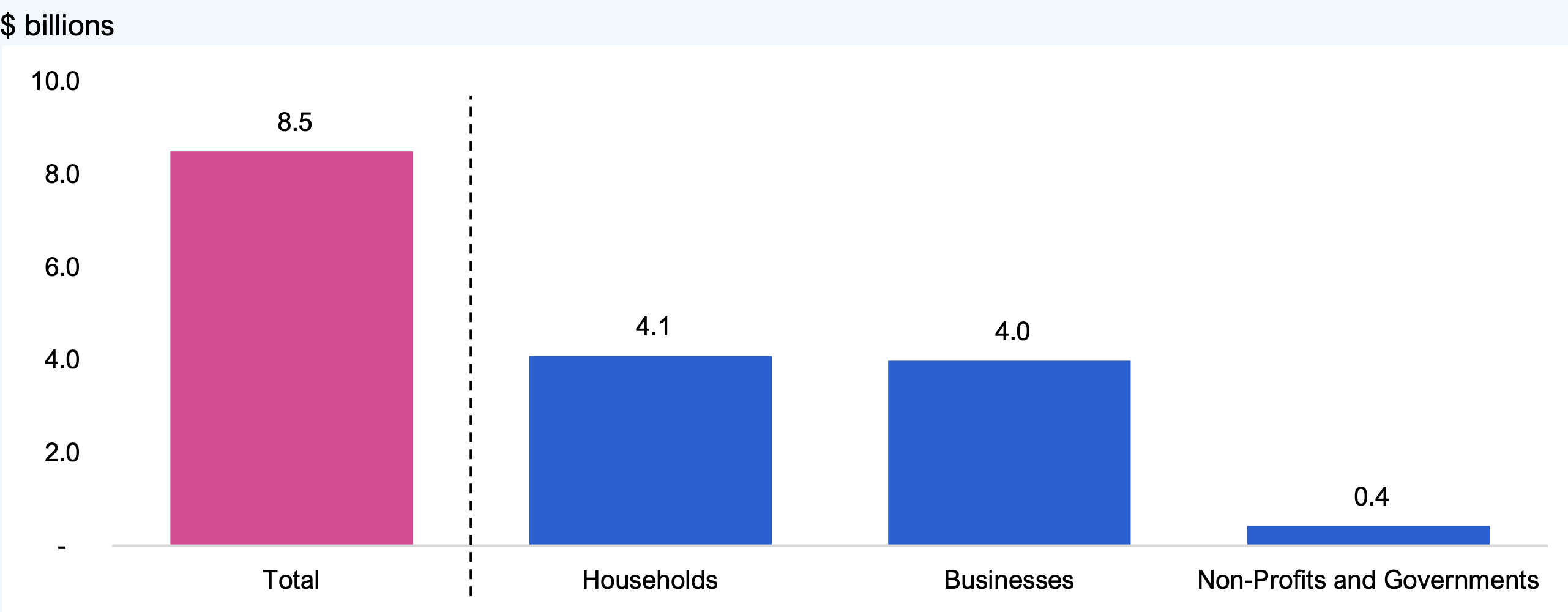
Note: These costs do not include price changes to other refined oil products or other commodities due to the war in Iran, or any reduction in fuel use due to higher prices, or any pass-through of price increases from businesses to households through supply chains.
Source: Statistics Canada Tables: 25-10-0030-01, 36-10-0478-01, Ontario Ministry Energy and Electrification’s Fuels price survey information, and FAO estimates.
Accessible version
| Total | Households | Businesses | Non-Profits and Governments | |
|---|---|---|---|---|
| $ billions | 8.5 | 4.1 | 4.0 | 0.4 |
Under these assumptions, higher gasoline and diesel prices would add an estimated $648 in additional fuel costs to the average Ontario household in 2026. This impact does not include the higher costs of other commodities caused by the war in Iran (e.g., fertilizer or jet fuel), or the pass-through of higher fuel costs through supply chains to other goods and services that households consume. To the extent that businesses pass on higher fuel costs to consumers, the additional fuel-related costs would be higher for households.
Implications of Recent Economic Trends
Looking ahead to the full year, the FAO’s latest Economic and Budget Outlook[19] (EBO), released in February 2026, projected that Ontario’s annual real GDP would rise by 1.4% in 2026, while consumer price inflation was expected to be 2.1%.
Recent economic data and global events have put downside pressure on the FAO’s projection for 2026 real GDP growth, and upside pressure on the FAO’s projection for 2026 consumer price inflation.
- Real GDP declined in the fourth quarter of 2025, weaker than projected by the FAO in the February 2026 EBO, reducing momentum heading into 2026.
- Recent data indicate that Ontario’s population growth was weaker than anticipated, which could put downward pressure on economic growth. Compared to a year earlier, Ontario’s population decreased by 0.2% in 2025 Q4 and by 0.7% in 2026 Q1, marking the first time the province’s population decreased based on records back to 1951. The decline was caused by a significant outflow of non-permanent residents and fewer new permanent residents.
- The war in Iran has disrupted global supply chains and raised oil prices dramatically, which will lift inflation and could slow household and business spending. Since February, the monthly average West Texas Intermediate crude oil price has risen from $65 US per barrel to $105 US per barrel, an increase of $40 US (62%).[20] According to the 2025 Ontario Budget, a sustained increase of $10 US per barrel would lower Ontario real GDP growth in 2026 by 0.1 to 0.3 percentage points.[21]
The FAO will continue to monitor Ontario’s economic performance and will update its forecast for economic growth in its next Economic and Budget Outlook report.
Figure 16 Recent economic trends indicate downward pressure on the FAO’s 2026 economic growth projections, and upward pressure on the outlook for consumer price inflation
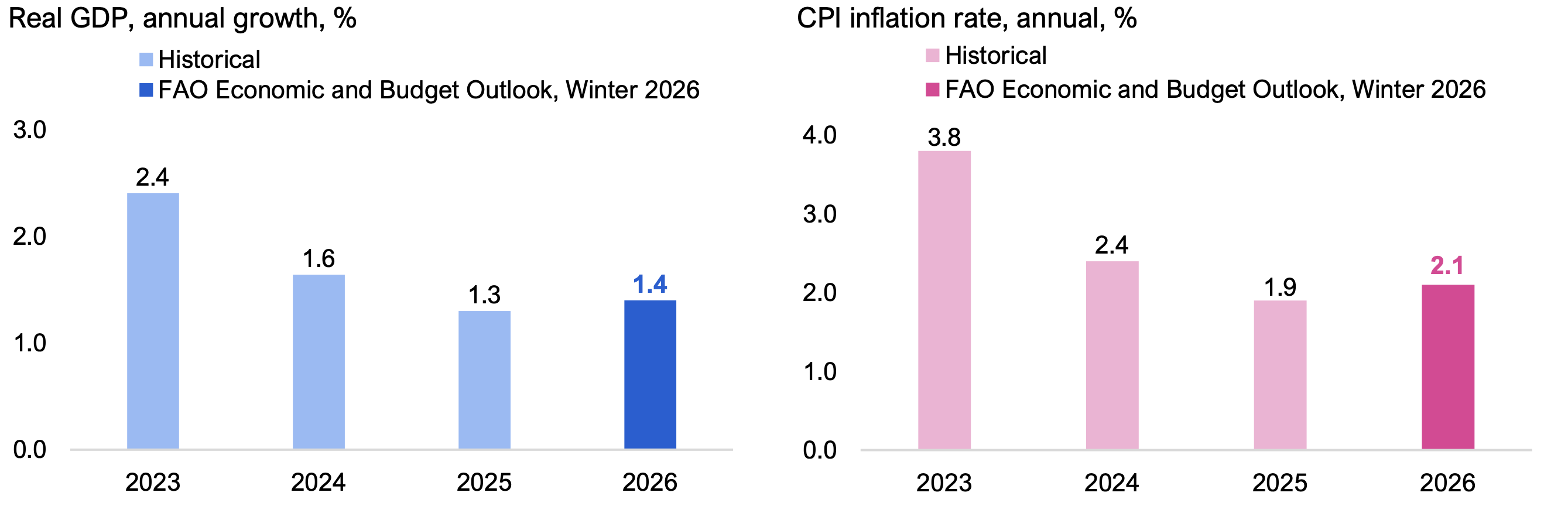
Source: Ontario Economic Accounts, Statistics Canada Table 36-10-0222-01 and Table 18-10-0004-01, and FAO.
Accessible version
| Real GDP annual growth, % | Historical | FAO Economic and Budget Outlook, Winter 2026 | CPI inflation rate, annual growth, % | Historical | FAO Economic and Budget Outlook, Winter 2026 |
|---|---|---|---|---|---|
| 2022 | 2.4 | 2023 | 3.8 | ||
| 2023 | 1.6 | 2024 | 2.4 | ||
| 2024 | 1.3 | 2025 | 1.9 | ||
| 2025 | 1.4 | 2026 | 2.1 |
Glossary
Economic Indicators
- Gross Domestic Product (GDP)
- GDP is a broad indicator of economic activity that measures the value of goods and services produced by an economy. GDP is measured on both an expenditure and income basis.
- Employment and unemployment rate
- Employment from Statistics Canada’s Labour Force Survey estimates the number of individuals who did any work at a job or business (whether paid or unpaid) or those who had a job but were not at work due to factors unrelated to their job (e.g., their own illness or a labour dispute). The unemployment rate represents the number of people actively looking for work but not having a job as a share of the labour force. These two indicators are the most common measures of labour market performance.
- Average hourly wages
- Hourly wages are measured before taxes and other deductions, and include tips, commissions and bonuses for both hourly and salaried workers. This metric indicates wage gains and labour market tightness.
- Retail sales
- Retail sales are the value of finished goods sold by retailers to the general public. This metric provides information on household spending by major commodity type.
- Housing resales
- Home resales data show the number of existing houses sold and is the most common measure of housing market activity.
- Housing prices
- The average price of existing houses sold. This metric is the most common measure of home prices that provides an indication of housing market strength.
- Housing starts
- Housing starts measures the number of housing units where construction has been started, including single and multiple unit dwellings. This metric provides a measure of change in the level of housing stock and can be compared to population growth to provide information on housing supply adequacy.
- Manufacturing sales
- The value of goods manufactured in Ontario that have been shipped to a customer.This metric is a measure of industrial production.
- Wholesale trade
- The value of merchandise sold in large quantities to retailers, businesses and institutional clients, such as governments. This metric provides insight into general business sector activity.
- International merchandise exports and imports
- The value of merchandise shipped out of the country from Ontario (exports) or into Ontario from outside the country (imports). International merchandise trade plays an important role in economic growth and provides information on the province’s competitiveness with other jurisdictions.
Technical Definitions
- Real dollars
- Values reflect prices after adjusting for inflation.
- Seasonally adjusted
- Data have been adjusted to reflect seasonal factors that may impact the data.
- Non-seasonally adjusted
- Data have not been adjusted to reflect seasonal factors.
- Year-over-year (Y/Y)
- Data from a particular time period are compared with data from the same time period a year ago. For example, Y/Y growth in 2023 Q4 would compare 2023 Q4 data with 2022 Q4 data. Using Y/Y data mostly removes the impact of seasonal factors.
- Quarter-over-quarter (Q/Q)
- Data compared from one quarter to the next. Q/Q growth in 2023 Q4 would compare 2023 Q4 data with 2023 Q3 data. Q/Q growth may suffer from seasonal factors unless data are seasonally adjusted.
Methodology
Data used in this report are primarily presented on a quarterly basis. For economic indicators that are adjusted for seasonality, growth is presented from one quarter to the next (Q/Q). For indicators that are not seasonally adjusted, growth is presented from the same quarter of the previous year (Y/Y) to avoid the impact of seasonal factors on economic trends. Indicators are presented in current dollars unless otherwise specified.
For some economic data, including retail sales, manufacturing sales and wholesale trade, the final month of the quarter may not yet be available at the time of the report’s publication. In these cases, Statistics Canada’s national preliminary estimate is used to estimate Ontario’s growth in that month.
Footnotes
[1] See the FAO’s Economic and Budget Outlook, Winter 2026.
[2] The Fiscal Sustainability, Transparency and Accountability Act, 2019 states that the quarterly Ontario Economic Accounts should be released within 45 days of Statistics Canada’s release of the National Income and Expenditure Accounts.
[3] Some of these data are regularly revised, and the growth rates presented in this report may differ from updated data published in the future.
[4] After inventory accumulations in the second and third quarters, businesses withdrew from non-farm inventories in the fourth quarter. At the national level, Statistics Canada reported that “the largest withdrawals in the fourth quarter occurred in the manufacturing sector, followed by the wholesale trade sector. In the retail sector, motor vehicle inventories declined.” See Statistics Canada’s: Gross domestic product, income and expenditure, fourth quarter 2025.
[5] Ontario’s real exports rose 1.6% in 2025 Q4 while real imports rose by 0.3%, resulting in an improvement in net trade.
[6] Nominal GDP can also be measured on an expenditure basis which includes economy-wide prices. For a description of how GDP is measured see Appendix C: How GDP is measured of the Ontario Economic Accounts.
[7] All other sources of income include depreciation and taxes less subsidies.
[8] Source: Statistics Canada Table 14-10-0288-01 and FAO.
[9] Source: Statistics Canada Table 14-10-0355-01 and FAO.
[10] Long-term unemployment includes those unemployed who were looking for work or laid-off for 27 weeks or more. Statistics Canada Table 14-10-0342-01.
[11] Measured on a year-over-year basis.
[12] See Bank of Canada’s Canadian Survey of Consumer Expectations—First Quarter of 2026.
[13] Canada Mortgage and Housing Corporation (CMHC) defines a housing unit as being a “structurally separate set of self-contained living premises [with] … a private entrance from outside the building or from a common hall, lobby or stairway inside the building. The entrance must be one that can be used without passing through another separate […] unit”. See CMHC’s Starts and Completions Survey and Market Absorption Survey Methodology.
[14] Source: Canada Mortgage and Housing Corporation, Seasonally-adjusted Starts (Canada and provinces).
[15] May prices reflect average daily prices up to May 22, 2026. See Federal Reserve Bank of St. Louis, Crude Oil Prices: West Texas Intermediate (WTI).
[16] May prices reflect average weekly prices up to May 22, 2026. See the Ontario Ministry Energy and Electrification’s Fuels price survey information.
[17] See the U.S. Energy Information Administration’s Short-Term Energy Outlook, May 2026.
[18] The shares of fuel use are based on Statistics Canada’s 2022 Ontario Input-Output Tables.
[19] See the FAO’s Economic and Budget Outlook, Winter 2026.
[20] See Federal Reserve Economic Data.
[21] 2025 Ontario Budget, Table 2.7. The 2026 Ontario Budget did not include estimates of the impact of changes in key external factors on the province’s economic growth.