


July 29, 2026
The Honourable Donna Skelly
Speaker of the Legislative Assembly of Ontario
Main Legislative Building, Room 180
Queen’s Park
Toronto, Ontario
M7A 1A2
Dear Madam Speaker:
In accordance with section 14 of the Financial Accountability Officer Act, 2013, I am pleased to present the 2025-26 Annual Report of the Financial Accountability Officer for your submission to the Legislative Assembly at the earliest reasonable opportunity.
Sincerely,
 Jeffrey Novak
Financial Accountability Officer
Jeffrey Novak
Financial Accountability Officer
Officer’s Note
Over the last fiscal year, the Financial Accountability Office of Ontario (FAO) continued to strengthen and build on its work to provide independent analysis to the Legislative Assembly about the state of the Province’s finances, including the budget, and trends in the provincial and national economies.
In 2025-26, the FAO produced 21 reports and one interactive webpage tool, up from 14 reports and one interactive webpage tool in the prior year. Three of our top five reports in 2025-26, as measured by report views, focused on the Ontario economy: Ontario’s Labour Market in 2024, The Potential Impacts of US Tariffs on the Ontario Economy and Ontario Economic Monitor: January to June 2025. Our two other most popular reports in 2025-26 were research projects requested by Members of Provincial Parliament (MPPs):Ontario Health Sector: 2025 Spending Plan Review and Government Spending Trends: 1990 to 2023.
We introduced two new products in 2025-26. To support MPPs in their debate of the government’s budget motion, the FAO’s Ontario Budget Note series provides an overview and analysis of the Ontario Budget, including the outlook for the economy, budget balance, debt burden, revenues and spending. To provide transparency and information to MPPs as they use the FAO’s work, and to help the FAO improve the quality of its projections, the FAO Forecast Accuracy series reviews our forecast accuracy for Ontario’s budget balance, revenue and spending, with a particular emphasis on the most recent completed fiscal year.
Our office remains committed to improving support for MPPs. In 2025-26, the FAO held 33 briefings for MPPs and staff (up from 25 in 2024‑25), MPPs mentioned the FAO in the Legislative Assembly on 67 per cent of sitting days (46 per cent in 2024-25), five of the Legislative Assembly’s eight Standing Committees referenced the FAO’s work (five in 2024-25), and the FAO received 11 research requests from MPPs (seven in 2024-25).
Based on feedback received from MPPs and staff, the FAO enhanced its interactive Examining Ontario’s Expenditure Estimates webpage, a tool that allows MPPs to review a ministry’s Expenditure Estimates to the standard account level of detail, and to compare requested spending against actual spending over the previous four years. The FAO also released seven reports in 2025-26 in response to research requests from MPPs: Government Spending Trends: 1990 to 2023, An Update on Subsidized Housing Programs in Ontario and Spending Plan Reviews on the health sector; the Ministry of Education; the Ministry of Colleges, Universities, Research Excellence and Security; the Ministry of Children, Community and Social Services; and the government’s 10-year capital plan.
The end of 2025-26 marks the halfway point of my five-year mandate as Financial Accountability Officer. Looking forward, our activities and work will continue to be guided by the FAO’s mission to provide MPPs with independent, authoritative, accessible and timely financial and economic analysis.
Jeffrey Novak
Financial Accountability Officer

The FAO’s Mission and Mandate
Mission
To support the Legislative Assembly by providing members and committees with independent, authoritative, accessible and timely financial and economic analysis.
Mandate
The Financial Accountability Officer Act, 2013 sets out the mandate of the Financial Accountability Officer (the Officer). The Officer is required to provide independent analysis to the Assembly about the state of the Province’s finances, including the budget, and trends in the provincial and national economies.
In addition, the Officer may respond to requests from members and committees of the Assembly to undertake research into:
- the Province’s finances and trends in the provincial and national economies;
- the estimates and supplementary estimates submitted to the Legislature;
- the financial costs or financial benefits to the Province of any public bill that is before the Assembly; or
- to estimate the financial costs or financial benefits to the Province of any proposal that relates to a matter over which the Legislature has jurisdiction, including any proposal made by the Government or by any member of the Assembly.
Finally, at the request of the Standing Committee on Finance and Economic Affairs (the Committee), the Officer and his staff are required to attend meetings of the Committee and to provide assistance.
FAO Work in 2025-26
The FAO delivers its analysis to Members of Provincial Parliament (MPPs) and committees in the form of reports, interactive graphics and tools, learning modules, presentations, media releases, and videos, all of which are posted to the FAO’s website and social media channels to increase accessibility and awareness.
In 2025-26, the FAO produced:


In general, the FAO’s work covers three areas:
-
1
Ontario’s economy

-
2
The Province’s finances and budget

-
3
Financial analysis of government programs and policies

Ontario’s Economy
A leading issue facing Ontario’s economy in 2025-26 was the impact of US tariffs. In The Potential Impacts of US Tariffs on the Ontario Economy, the FAO highlighted the importance of exports to the US for the province’s economic performance. The report also provided estimates of expected impacts of US tariffs on Ontario’s exports, imports, GDP, employment and inflation.
The FAO provides semi-annual forecasts of Ontario’s economy through its Economic and Budget Outlook (EBO) reports. The Economic and Budget Outlook, Summer 2025 noted that Ontario was expected to record slower economic growth over the 2025 to 2026 period as US tariffs reduced demand for the province’s exports, and businesses cut back on investment and hiring. The Economic and Budget Outlook, Winter 2026 showed that economic growth slowed in 2025 and was projected to be little changed in 2026 as lower interest rates continue to provide some relief to households and residential investment, while business investment and exports remain subdued due to trade uncertainty.
The FAO covers the latest trends in Ontario’s economy through its quarterly Ontario Economic Monitor reports. These reports provide an overview of recent quarterly real GDP growth, the broadest measure of economic activity, followed by an analysis of trends in key economic indicators. Based on this information, the reports then provide an assessment of the FAO’s latest economic outlook. Key trends highlighted over the past year focused on how US tariffs affected Ontario employment by industry and major cities, and the province’s international trade patterns.
In a new report series introduced in 2025-26, the FAO analyzed the economic outlook in the 2025 Ontario Budget to support Members of Provincial Parliament in their debate of the government’s budget. The FAO’s 2025 Ontario Budget Note showed that the government’s economic outlook had deteriorated since the 2024 Ontario Economic Outlook and Fiscal Review (FES), largely due to the impact of US tariffs and elevated geopolitical uncertainty. The 2025 budget projected that Ontario’s real GDP, the broadest measure of economic activity, would grow by an average annual rate of 1.2 per cent from 2025 to 2027, 0.9 percentage points lower than the government’s outlook in the 2024 FES.
The FAO also produced Ontario’s Labour Market in 2024. The report highlighted that Ontario’s labour market continued to moderate in 2024, with employment rising by 140,000, down from the 242,000 jobs added in 2023. The average hourly wage of Ontarians increased by 5.2 per cent in 2024, the third fastest pace on record back to 1998 and more than double the 2.4 per cent annual inflation rate.
The Province’s Finances and Budget
The 2025 Ontario Budget Note also provided an overview and analysis of the 2025 budget projections for the budget balance, debt burden, revenues and spending. The report noted that the 2025 budget postponed the government’s projected balanced budget date to 2027-28, one year later than projected in the 2024 FES. The delay in the balanced budget projection was due to $20.6 billion in higher projected spending and $1.0 billion in lower expected revenue over the 2024-25 to 2026-27 period.
In addition to forecasts for the provincial economy, Economic and Budget Outlook (EBO) reports provide projections for the Province’s finances and compare the FAO’s budget outlook to the government’s plans presented in Ontario Budgets and Ontario Economic Outlook and Fiscal Reviews.
In the Economic and Budget Outlook, Summer 2025, the FAO projected Ontario’s budget deficit would widen from $1.3 billion in 2024-25 to $12.0 billion in 2025-26 and remain in deficit throughout the five-year outlook period. By 2029-30, the end of the outlook, the deficit was expected to be $9.0 billion as spending growth was projected to outpace revenue growth, particularly in the health sector and interest and other debt servicing charges. Over the outlook, Ontario’s net debt was projected to increase to $549.3 billion by 2029-30, due to an increase in accumulated budget deficits and non-financial assets, largely infrastructure assets owned by the Province and the broader public sector.
In the subsequent Economic and Budget Outlook, Winter 2026, the FAO updated its 2025-26 deficit projection to $11.1 billion, and continued to project budget deficits over the outlook, although by 2029-30 the budget deficit was projected to improve to $6.3 billion.
In another new report series introduced in 2025-26, FAO Forecast Accuracy, the FAO reviewed its forecast accuracy to provide transparency and information to MPPs as they use the FAO’s work, and to help the FAO improve the quality of its projections. The FAO Forecast Accuracy: 2024-25 showed that the FAO’s 2024-25 budget balance projection was $5.3 billion below the $1.1 billion actual budget deficit reported in the 2024-25 Public Accounts of Ontario. Since 2016-17, the FAO’s one-year average absolute variance for the budget balance was $8.5 billion, while the government’s average absolute variance was $10.0 billion. The FAO’s three-year average absolute variance for the budget balance was $5.5 billion, while the government’s was $9.7 billion.
The FAO provides quarterly information on government spending during the fiscal year through its Expenditure Monitor reports. These reports identify changes made by the Province to its spending plan for the current fiscal year, compare year-to-date spending against the government’s spending plan and spending in the previous year, and report on the status of the Contingency Fund. In 2025-26, the FAO released Expenditure Monitor 2024-25: Q4, which provided information on spending by the Province through the end of the 2024-25 fiscal year, and Expenditure Monitor 2025‑26: Q2, which reviewed provincial spending through the first two quarters of the 2025-26 fiscal year, from April 1, 2025 to September 30, 2025.
The FAO also provided a summary of the Province’s credit rating. The Province’s debt is rated by four principal international credit rating agencies, based on their assessments of Ontario’s economic and financial outlook, and future risks. These credit ratings represent the agencies’ opinions on the Province’s ability to meet its debt-related financial obligations. The FAO’s Ontario’s Credit Rating: Fall 2025 Update noted that the credit rating agencies rate the Province as an extremely strong, investment-grade borrower. Since the FAO’s last credit rating report, released in October 2024, S&P Global Ratings upgraded Ontario’s credit rating from A+ to AA-, while Moody’s Ratings revised its outlook for Ontario down from positive to stable.
Financial Analysis of Government Programs and Policies
At the request of MPPs and committees, or on the initiative of the Officer, the FAO provides financial analysis of government programs and proposals. In 2025-26, the FAO released the following reports and other products:
Examining Ontario’s 2025-26 Expenditure Estimates
To support Standing Committees’ reviews of ministries’ Expenditure Estimates, the interactive webpage Examining Ontario’s 2025-26 Expenditure Estimates allows users to review a ministry’s Expenditure Estimates to the standard account level of detail and compare requested spending against actual spending over the previous four years. For 2025-26, the FAO prepared information for five ministries, which accounted for 72 per cent of the Province’s 2025-26 spending plan in the 2025 Ontario Budget.
Spending Plan Reviews
As part of the FAO’s Spending Plan Reviews series, the FAO released four reports that examined the 2025 Ontario Budget spending plans for the health sector (including the Ministries of Health and Long-Term Care); the Ministry of Education; the Ministry of Colleges, Universities, Research Excellence and Security; and the Ministry of Children, Community and Social Services. These reports compared each ministry’s spending plan against historical spending and the FAO’s projection of the funding required to maintain 2024-25 service levels. The reports also analyzed the potential impact of each ministry’s spending plan on selected programs and service level indicators, and compared Ontario’s historical spending against spending by the other provinces.
The FAO also reviewed the Province’s 10-year infrastructure spending plan in the 2025 Ontario Budget. The report examined Ontario’s capital plan by analyzing how planned infrastructure spending was allocated across sectors, funding sources and types of projects, and compared the 2025 capital plan to previous budget capital plans and to actual infrastructure spending over the past 10 years.
Government Spending Trends: 1990 to 2023
This report reviewed trends in Government of Ontario spending from 1990‑91 to 2023‑24, including changes in nominal spending, real per capita spending and spending as a share of GDP. The report also examined trends in federal government transfers to Ontario and analyzed federal transfers as a share of provincial spending.
An Update on Subsidized Housing Programs in Ontario
This report reviewed historical and projected spending on provincial subsidized housing programs, estimated the number of households supported, and projected the impact of those programs on subsidized housing need in Ontario. The analysis examined funding trends across levels of government and assessed how provincial housing assistance programs affect the number of households in need of subsidized housing.
FAO Support for MPPs and Committees
The FAO provides independent financial and economic analysis to the members and committees of the Legislative Assembly of Ontario.
 67% of Sitting Days FAO Mentioned in the House
 The FAO primarily supports MPPs and committees through reports, interactive graphics and tools, learning modules, presentations, media releases, and videos. In addition, the FAO accepts research requests from MPPs and committees, offers briefings, produces a quarterly newsletter, and posts all of its work to the FAO’s website and social media channels.
One measure of the effectiveness of the FAO’s support for MPPs is through the use of our work in the Legislative Assembly and committees. In 2025-26, MPPs mentioned the FAO in the Legislative Assembly on 67 per cent of sitting days, up from 46 per cent in 2024-25.
Percentage of Sitting Days FAO Mentioned in the Legislative Assembly
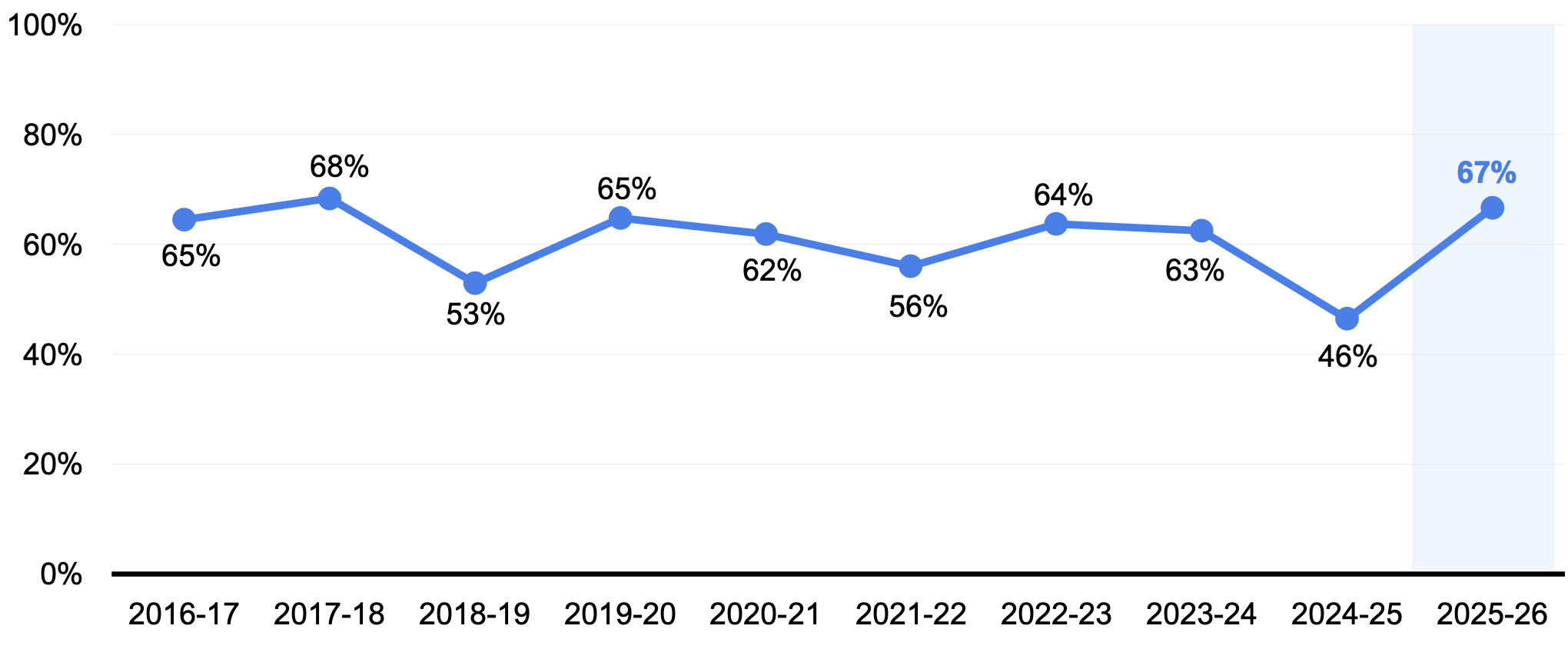
Accessible version
| Fiscal year | Percentage of Sitting Days |
|---|---|
| 2016-17 | 65% |
| 2017-18 | 68% |
| 2018-19 | 53% |
| 2019-20 | 65% |
| 2020-21 | 62% |
| 2021-22 | 56% |
| 2022-23 | 64% |
| 2023-24 | 63% |
| 2024-25 | 46% |
| 2025-26 | 67% |
 5 Standing Committees Referenced FAO Work
 Of the Legislative Assembly’s eight Standing Committees, five referenced the FAO’s work in 2025-26, led by the Standing Committee on Social Policy and the Standing Committee on Finance and Economic Affairs, followed by the Standing Committee on Public Accounts, the Standing Committee on the Interior, and the Standing Committee on Justice Policy.
Research Requests
As mandated by the Financial Accountability Officer Act, 2013, the FAO accepts research requests from MPPs and committees under the following categories:
 11 Research Requests from MPPs
 - the Province’s finances and trends in the provincial and national economies;
- the estimates and supplementary estimates submitted to the Legislature;
- the financial costs or financial benefits to the Province of any public bill that is before the Assembly; or
- to estimate the financial costs or financial benefits to the Province of any proposal that relates to a matter over which the Legislature has jurisdiction, including any proposal made by the Government or by any member of the Assembly.
The Financial Accountability Officer has the discretion to accept or reject a research request. The FAO considers whether the research request aligns within the Officer’s legislated mandate, whether the research request is expected to be feasible, and resource requirements.
In 2025-26, the FAO received 11 research requests from MPPs and accepted nine.
 33 Briefings for MPPs and Staff
 Briefings
All work produced by the FAO is accompanied by briefings for interested MPPs, committees and staff. Each briefing includes an overview presentation and an opportunity for attendees to ask questions. To accommodate schedules, the FAO offers two briefings for interested MPPs and staff on the day a report is released. On request, the FAO will also schedule additional briefings for MPPs, committees or staff. In 2025‑26, the FAO held 33 briefings for MPPs and staff, up from 25 in 2024‑25.
Newsletters
The FAO releases a quarterly newsletter as a resource for MPPs and subscribers to stay informed on FAO activities. Each newsletter summarizes the FAO’s work over the previous quarter and lists upcoming FAO reports and other work, including research projects initiated at the request of MPPs.
 224,065 Website Views
 Website
All of the FAO’s work is publicly available on our website. In 2025-26, the FAO’s website accumulated 224,065 views, a record for the FAO and a 12 per cent increase from 2024-25.
The FAO’s most popular report released in 2025-26, as measured by website views and downloads, was Ontario’s Labour Market in 2024.
The next most popular reports released in 2025-26 were:
FAO Website Views
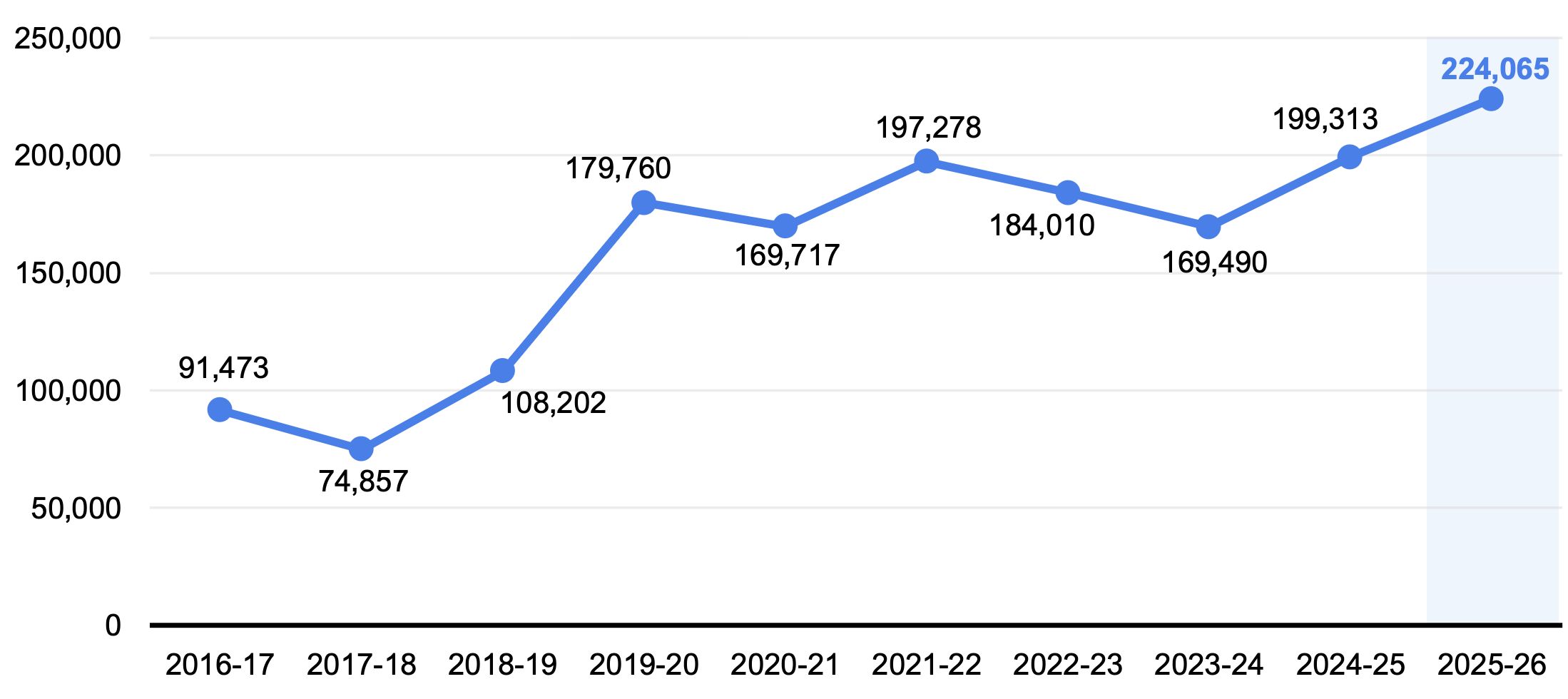
Accessible version
| Fiscal year | Views |
|---|---|
| 2016-17 | 91,473 |
| 2017-18 | 74,857 |
| 2018-19 | 108,202 |
| 2019-20 | 179,760 |
| 2020-21 | 169,717 |
| 2021-22 | 197,278 |
| 2022-23 | 184,010 |
| 2023-24 | 169,490 |
| 2024-25 | 199,313 |
| 2025-26 | 224,065 |
Social Media and Email Subscribers
FAO social media platforms are a key resource for MPPs and the public to stay up to date with FAO activities and reports. The FAO’s work is shared across three social media platforms: LinkedIn, X (formerly Twitter) and Instagram. FAO content posted on these platforms allows MPPs and staff to access the FAO’s work through a simple and quick medium.
Additionally, MPPs, staff, media and members of the public are able to subscribe to FAO News Alerts to receive email notifications on reports, interactive tools and newsletters.
In 2025-26, email subscribers increased by 20 per cent and LinkedIn followers increased by nine per cent, while X followers decreased by one per cent and Instagram followers decreased by eight per cent.
 20%
20%  Email Subscribers
  9% LinkedIn Followers
  1%
1%  X Followers
  8% Instagram Followers
 Access to and Disclosure of Information
Access to Information
Access to government information is a key requirement for the FAO to meet its legislated mandate. Under the Financial Accountability Officer Act, 2013, ministries and public entities have a statutory duty to provide the FAO, free of charge and in a timely manner, with any financial, economic or other information that the Officer believes necessary to perform his duties, with the exception of Cabinet records (see below) and personal information.
In addition, through four orders in council starting in 2016, Executive Councils have authorized ministries and public entities to provide the FAO with access to certain information contained in Cabinet records.
Disclosure of Information
Although the FAO has access to a wide range of information, the Financial Accountability Officer Act, 2013 and the orders in council place important restrictions on the FAO’s ability to publicly disclose certain types of non-public information that it receives from ministries and public entities.
Accordingly, the FAO has put in place internal processes that ensure information subject to these restrictions is not publicly disclosed. As part of these processes, ministries and public entities provide advice to the FAO, which helps to ensure that the FAO complies with its disclosure of information obligations.
In 2025-26, the FAO maintained its professional working relationship with ministries and public entities. The FAO made 36 information requests (19 in 2024-25) and was provided with access to requested information for 35 requests, while one request remains outstanding.
Financial Statement
The Financial Accountability Office of Ontario’s fiscal year runs from April 1 to March 31.
Total spending (unaudited) by the FAO in 2025-26 was $4,342,086. This was $240,614 (-5.3 per cent) less than the FAO’s approved budget for 2025-26 and $80,169 (1.9 per cent) more than total spending in 2024-25.
The accounts and financial statements of the FAO are audited annually by the Office of the Auditor General of Ontario. This financial statement was unaudited at the time of publication.
| 2025-26 Budget | 2025-26 Actual (Unaudited) | 2024-25 Actual | |
|---|---|---|---|
| Salaries and wages | $3,043,000 | $3,020,876 | $3,053,927 |
| Employee benefits | $730,300 | $702,328 | $602,361 |
| Transportation and communication | $56,500 | $7,927 | $16,154 |
| Services | $642,900 | $573,064 | $481,515 |
| Supplies and equipment | $110,000 | $37,891 | $107,960 |
| Total | $4,582,700 | $4,342,086 | $4,261,917 |
The Year in Review
21 Reports 1 Interactive Tool 21 Presentations 18 Media Releases 
Views
 11 Research Requests from MPPs
  67% of Sitting Days FAO Mentioned in the House
  5 Standing Committees Referenced FAO Work
  33 Briefings for MPPs and Staff 20% Email Subscribers 9% LinkedIn Followers 1% X Followers 8% Instagram Followers
 Accessible version
- 21 reports.
- 1 interactive tool
- 21 presentations
- 18 media releases
Top 5 Report Views:
- Ontario Economic Monitor: January to June 2025: 5,815 views.
- Government Spending Trends: 1990 to 2023: 7,415 views.
- Ontario Health Sector: 2025 Spending Plan Review: 14,160 views.
- The Potential Impacts of US Tariffs on the Ontario Economy: 19,298 views.
- Ontario’s Labour Market in 2024: 19,638 views.
224,065 Website Views.
Supporting MPPs & Committees:
- 11 Research Requests from MPPs.
- 67% of Sitting Days FAO Mentioned in the House.
- 5 Standing Committees Referenced FAO Work.
- 33 Briefings for MPPs and Staff.
- 20% increase in Email Subscribers.
- 9% increase in LinkedIn Followers.
- 1% decrease in X Followers.
- 8% decrease in Instagram Followers.